
Want to know what your cards are worth? Stakks is free.
Search for the best sports card scanning app and you get a dozen listicles, most of them written by the apps themselves and most of them ending with the same conclusion: the app that published the article. So, disclosure first. We make Stakks, one of the apps below. We have tried to write the comparison we wanted when we started, which means saying where Stakks is the wrong choice.
No single app wins. Ludex has the strongest reputation on modern parallels and adds eBay listing tools. CollX attaches a scanner to its own marketplace. Center Stage pairs a price guide with a social marketplace. Card Ladder and Slabfy serve investors and dealers. Stakks handles the scan, price and organize loop across five sports without a marketplace. Pick based on what you do with your cards after the scan.
Updated September 29, 2026. Every price and feature below was checked against the app’s own App Store listing or website on that date. Apps change their plans often, so confirm on the listing before you pay.
What actually separates one card scanner app from another
Every app in this category scans a card and shows a number. The differences that matter are narrower than the marketing suggests, and there are four of them.
Accuracy on parallels, not base cards. Any scanner can read a base Topps Series 1 card. The test is whether it can tell a base card from a Silver Prizm, a numbered parallel, or a refractor, because that distinction is often the difference between a $2 card and a $200 one. Hard public numbers are scarce. One comparison published by Cards AI in June 2026 reported that Ludex named the specific parallel on 85% of cards, while CollX matched the base card but missed the parallel about 35% of the time. Cards AI competes with both apps and does not say how many cards that part of the test covered. We have not replicated it, so read it as one data point and run the five-minute test further down on your own cards.
Where the price actually comes from. This is the least understood and most important difference. A price built on completed sales tells you what buyers paid. A price built on asking prices tells you what sellers hope for. Ludex says its values are based on actual completed sales. CollX says it uses millions of historical auction prices to calculate a card’s average value. The same Cards AI article compared each app’s quote with the median of recent eBay sold listings on 50 cards and reported Ludex about 8% above and CollX about 22% above. Again, that is a competitor’s test on a small sample. The habit that protects you is the same with any app: check sold listings before you price anything that matters.
What the free tier really allows. “Free” means different things. Ludex lists unlimited scans on its free membership but caps the collection at 60 cards. CollX is free to scan with, and keeps unlimited collection size for CollX Pro. Center Stage has announced it is removing its scan limit altogether. Cards AI offers a 7-day trial on its annual plan.
What happens after the scan. An app that scans into a marketplace is a different product from an app that scans into a collection. CollX and Center Stage want you buying and selling inside them. Ludex gives you tools to list on eBay. Slabfy is built around running a card business. Stakks stops at the collection and its total value. Neither approach is better in the abstract, but one of them will annoy you daily.
Sports card scanner app pricing in 2026
| App | Free tier | Paid plans |
|---|---|---|
| Ludex | Unlimited scans, up to 60 cards in your collection, 5 eBay listings a month | Lite $4.99/mo, Standard $9.99/mo or $89.99/yr, Pro $24.99/mo or $239.99/yr |
| CollX | Free to scan and collect; unlimited collection size is a Pro feature | Pro $9.99/mo or $99.99/yr, Gold $24.99/mo or $249/yr |
| Center Stage | Unlimited free scanning announced for its next major update | Paid memberships being retired; scan passes and credits still listed |
| Card Ladder | Search card values, daily sales recaps, hobby news | Pro $19.99/mo or $199.99/yr |
| Slabfy | 14-day free trial on monthly plans | Collector $10/mo, Collector Plus $20/mo, Dealer $40/mo, Shop $149/mo |
| Cards AI | 7-day free trial on the annual plan | $8.99/week or $59.99/yr |
| Stakks | Free to start, plus 3 free scans per tool in the browser | Optional Pro subscription |
| TCDB, SportsCardsPro | Free to use | Not the focus of this comparison |
Sources: each app’s US App Store listing, and slabfy.com for Slabfy, all read on September 29, 2026.
The main sports card scanner apps, one by one
Ludex — the accuracy pick
Ludex has the strongest reputation for identification, particularly on the modern parallels that trip up everything else, and it describes its values as based on actual completed sales. It covers baseball, basketball, football, soccer, hockey, MMA, wrestling and racing, plus trading card games such as Pokémon and Magic. Its List-It feature pushes cards to eBay, which matters if you sell in volume.
The free membership is more usable than most people assume: scans are unlimited. The catch is the collection, which stops at 60 cards, and eBay listings, which stop at 5 a month. Building a real collection means a paid plan, from $4.99 a month for one category to $24.99 a month for Pro.
Choose it if: modern parallels, numbered inserts, and selling on eBay are your normal.
CollX — the marketplace pick
CollX scans against a database it puts at 20+ million cards and covers far more than the big sports, including golf, tennis, boxing, trading card games and non-sport sets. Its defining feature is the CollX marketplace, where you can buy with a credit card, bundle cards into deals, and sell with tracked shipping.
CollX Pro, at $9.99 a month or $99.99 a year, adds unlimited collection size, CSV export, printable checklists and a monthly marketplace credit. If you only want a number for a card and a tidy collection, the marketplace and social layers are more app than you need.
Choose it if: you want to buy and sell inside the same app you scan with.
Stakks — the simple scan, price and organize pick
Ours. Stakks scans a card, identifies the player, year, set, brand, card number, rarity and variation, then shows an estimated market value with a low-high range and a trend indicator. Cards save into named collections, and each collection carries a running total value. It covers baseball, basketball, football, hockey and soccer, and it is free to start with an optional Pro upgrade.
What Stakks does not do, plainly: there is no marketplace and no buying or selling, no PSA or BGS grade lookup and no grading of your card from a photo, no CSV export of your collection, and no desktop app. If any of those are requirements, one of the others here fits you better. Stakks is also newer than Ludex and CollX, which means a smaller community around it.
Choose it if: you want the scan to value to collection loop with no marketplace attached, across several sports, without paying to start.
Center Stage — price guide plus social marketplace
Center Stage describes itself as an instant price guide that returns historical sales in under a second, with a social marketplace and collection management alongside. It supports basketball, baseball, football, soccer, F1 racing and hockey, with limited support for Pokémon and Magic.
The notable change in 2026 is pricing. Center Stage has announced that unlimited scanning, previously part of a paid membership, will be free for everyone with its next major update, and that it is retiring its paid membership plans. That makes it worth a fresh look if a scan limit put you off before.
Choose it if: you want sales history and a community marketplace, or you collect F1 cards.
Card Ladder — for following the market
Card Ladder presents itself as a price guide and collection tracker rather than a camera scanner. The free version lets you search card values, read daily sales recaps and follow the Card Ladder Index. Card Ladder Pro, at $19.99 a month or $199.99 a year, adds all-time sales history from every marketplace, collection value tracking, player market tracking and price alerts.
Choose it if: you treat cards as a portfolio and want sales history and indexes more than a quick scan.
Slabfy — for dealers and card shows
Slabfy is aimed at people running a card business. Its site lists Price Check for pricing a card at a show, bulk intake for scanning a stack, Flip Finder for underpriced eBay listings, a card show point of sale, consignment tracking and a grading calculator. Plans run from Collector at $10 a month for 500 cards to Shop at $149 a month for 25,000 cards, with a 14-day trial on monthly plans.
Choose it if: you work a vendor table, manage consignments, or reprice hundreds of listings.
Cards AI — sold-price data with a condition estimate
Cards AI prices from recent sold data and adds an AI condition analysis that scores centering, corners, edges and surface, which is useful when you are deciding whether a card is worth submitting for grading. It supports baseball, basketball, football and hockey, along with trading card games. It costs $8.99 a week or $59.99 a year, and the annual plan includes a 7-day free trial.
SportsCardsPro, TCDB and the free trackers
These are databases rather than scanners. TCDB is a free community database and the usual choice for cataloging vintage by set and card number. SportsCardsPro is a free online price guide. For pre-1980 cards, honestly, a database plus eBay sold listings will beat any scanner app, because the scanners are all weakest exactly there.
Best sports card scanning app by what you collect
| If you are… | Best pick | Why |
|---|---|---|
| Chasing modern parallels and refractors | Ludex | Strongest reputation where identification is hardest |
| Buying and selling inside an app | CollX or Center Stage | Both attach a marketplace to the scanner |
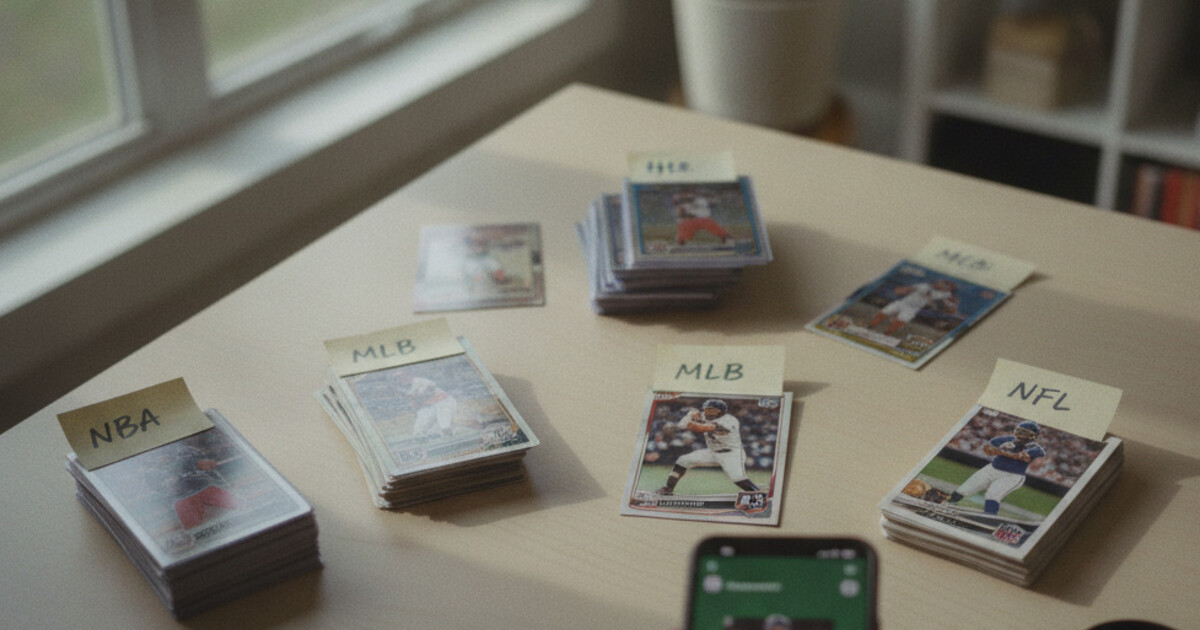
| Triaging an inherited shoebox | Ludex, CollX or Stakks | All scan free; you are checking for value, not building a catalog |
| Tracking a collection’s total value | Stakks | Collections with running total value, no marketplace noise |
| Following prices like an investor | Card Ladder | Sales history, indexes and price alerts |
| Running a show table or consignments | Slabfy | Built around dealer workflows |
| Deciding what to send for grading | Cards AI | Condition estimate alongside sold-price data |
| Collecting F1 cards | Center Stage or Ludex | Both list racing among supported categories |
| Cataloging pre-1980 vintage | TCDB plus eBay sold | Scanners are least reliable on vintage |
| Scanning a couple of cards, once | A free web scanner | No download needed, try one here |
How to test any card scanner app in five minutes
Reviews go stale as apps update. Run this yourself before committing to a subscription.
Pick three cards from your own collection: one base card of a well-known player, one parallel or insert you already know the identity of, and one vintage card if you have one. Scan all three in every app you are considering.
Then check two things. Did it name the exact version, including the parallel, or did it default to the base card? And does the price it shows match what that card actually sold for on eBay in the last 90 days, using the Sold Items filter?
That fifteen-minute exercise tells you more than any listicle, including this one. If an app misses the parallel on a card you already know, it will miss them on cards you do not.
Where Stakks fits, honestly
Stakks makes sense if the loop you want is: point the camera, learn what the card is and roughly what it is worth, save it to a collection, watch the total. It covers five sports, it starts free, and it stays out of the way. That is the whole pitch.
It is not the app for you if you want to sell inside the app, need certified grades, or run dealer-level volume where parallel accuracy at the margin decides your margins. Ludex and CollX earned their positions and we are not going to pretend otherwise.
If you want to test the identification and pricing before installing anything, the free browser scanner gives you three scans with no sign-up. Same engine, no commitment. And if you just want to know what one specific card is worth, that tool answers it directly.
For more on reading the numbers these apps give you, our guide on what your card is actually worth covers why every estimate is a range and how to place your copy inside it.
Frequently Asked Questions
What is the best sports card scanner app?
There is no single winner. Ludex has the strongest reputation on modern parallels and suits set builders and sellers. CollX and Center Stage suit collectors who want a marketplace next to the scanner. Card Ladder suits people who follow prices. Stakks covers the scan, price and organize loop across five sports with no marketplace. Match the app to what you do after the scan.
Is there a free sports card scanner app?
Several. Ludex lists unlimited scans on its free membership, with a collection of up to 60 cards. CollX is free to scan with and keeps unlimited collection size for Pro. Center Stage has announced free unlimited scanning. Stakks is free to start with an optional Pro upgrade. For a one-off check, the free web scanner needs no download at all.
How much do sports card scanner apps cost in 2026?
Ludex runs $4.99, $9.99 or $24.99 a month depending on the plan. CollX Pro is $9.99 a month or $99.99 a year, and CollX Gold is $24.99 a month. Card Ladder Pro is $19.99 a month. Cards AI is $8.99 a week or $59.99 a year. Slabfy starts at $10 a month. Center Stage is retiring its paid memberships. These come from each app’s own listing on September 29, 2026, and the pricing table above has the detail.
What is the best app to scan sports cards for value?
Judge it by where the price comes from. Prefer an app that builds its number on completed sales and shows you the sales behind it. Treat every app number as an estimate and verify high-value cards against sold listings.
What is the best scanner for baseball cards?
For modern baseball with parallels and numbered inserts, Ludex has the strongest reputation for telling variations apart. For vintage baseball, no scanner is fully dependable; TCDB plus eBay sold listings works better. For sorting a mixed shoebox, any major scanner does the job. See our baseball card value guide for the manual method.
How accurate are sports card scanner apps?
Base card identification is reliable everywhere. Accuracy falls on parallels, refractors and short prints, and every app is weakest on pre-1980 vintage. Confirm the year, set and parallel yourself before acting on a price for anything expensive.
Whichever app you land on, the useful habit is the same: scan first, then verify anything that comes back with real money attached. Try Stakks free if the simple version is what you are after.