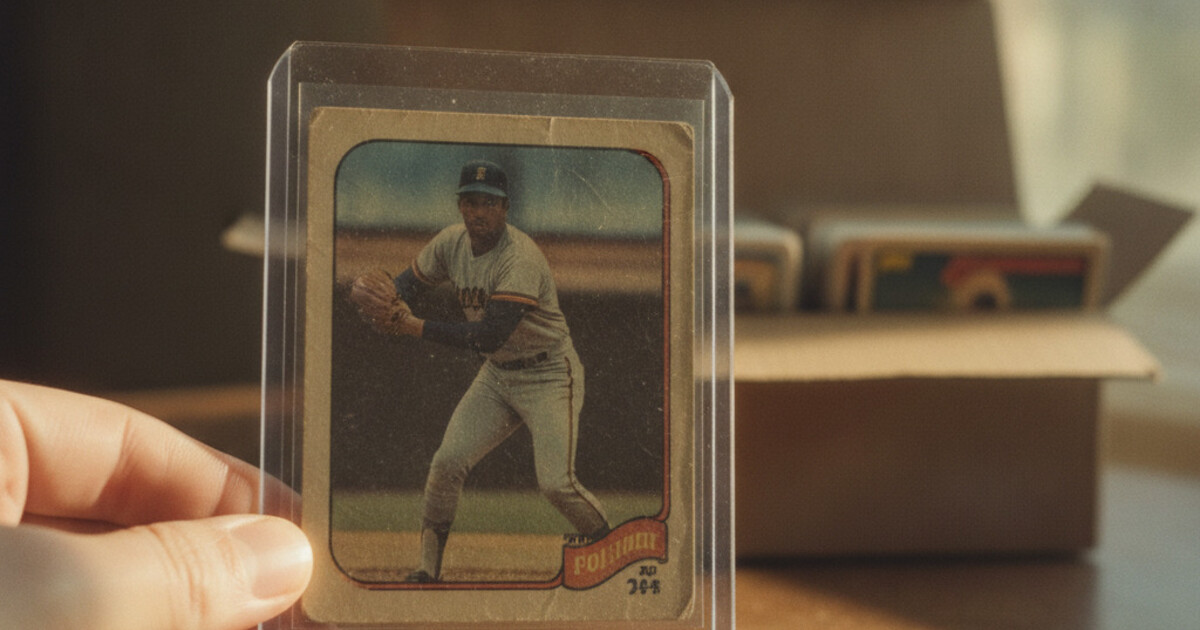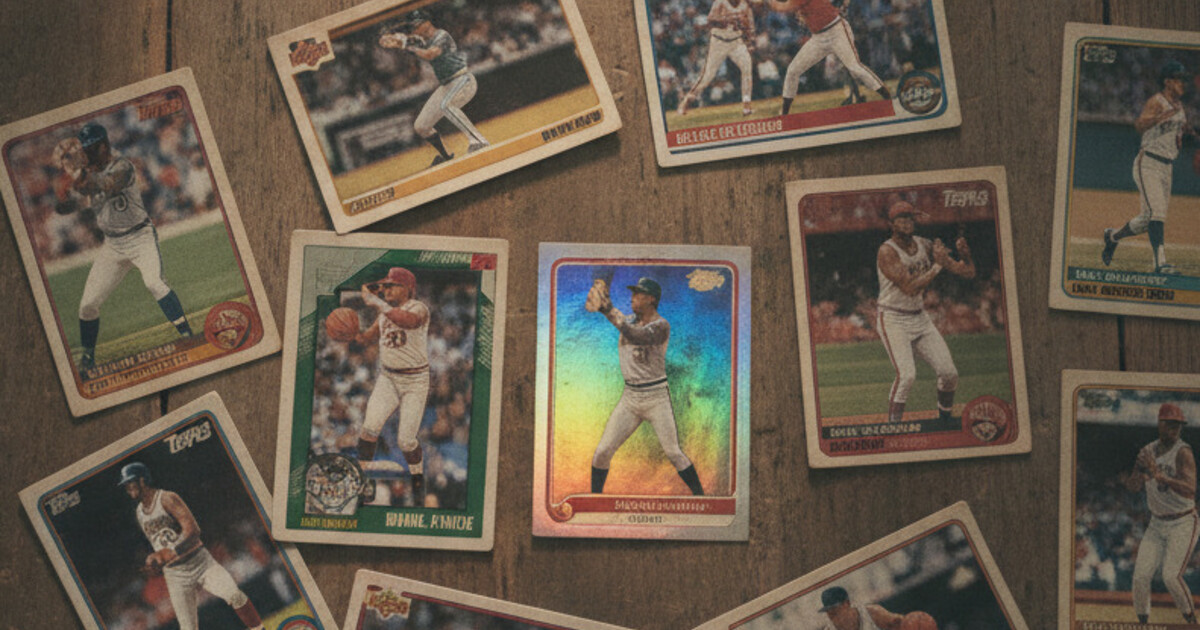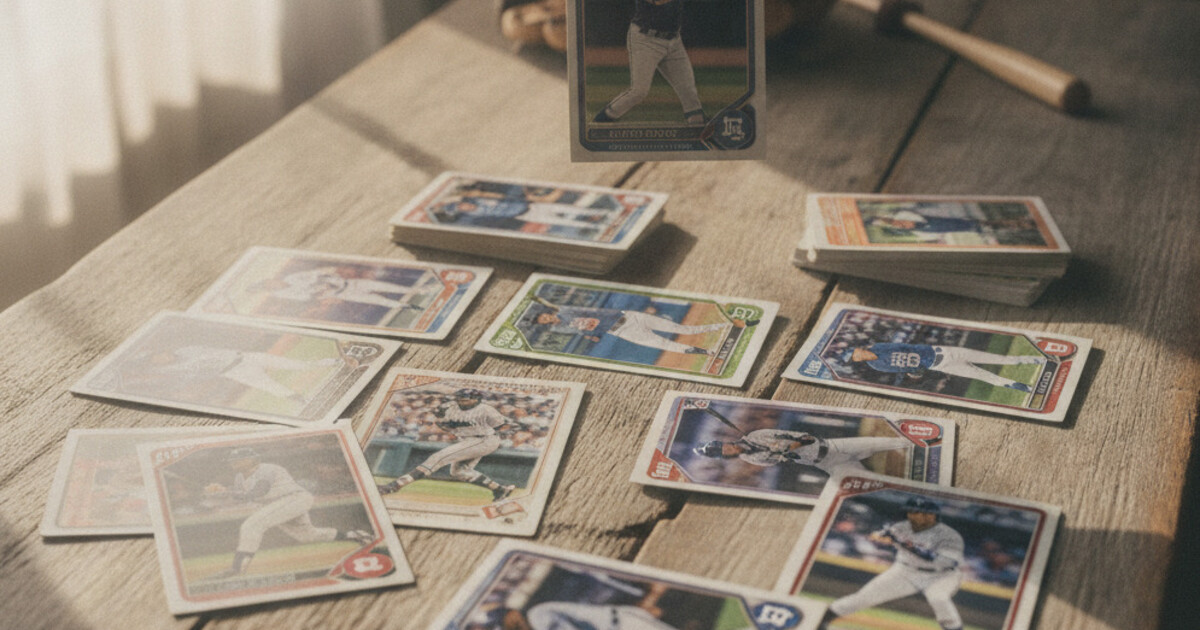

Want to know what your cards are worth? Stakks is free.
“How much is my baseball card worth?” sounds like a simple question until you’re staring at a 1989 Ken Griffey Jr. Upper Deck rookie and getting eBay results that range from $8 to $800. That’s not a typo. Condition, print run, set variation, and recent sales data all pull the same card’s price across an enormous range. Knowing which factors matter and where to look cuts through the noise fast.
To find out how much a baseball card is worth, identify the player, year, set, card number, and condition first. Then check recent eBay “sold” listings for that exact card. A scanner app like Stakks can pull all of this information automatically and return a market estimate in seconds, with a low/high price range included — or you can scan a baseball card free in your browser right now, no download needed.
Why Baseball Card Values Vary So Much
Baseball card values depend on six distinct variables: player performance, year and set, print run, condition, card type, and recent sales velocity. A 1989 Ken Griffey Jr. Upper Deck rookie in PSA 10 condition has sold for $650+, while the same card in PSA 6 condition sells for under $50. Print run shapes scarcity directly: base cards printed in the millions trade at $1-3, while numbered parallels printed to /25 jump to $200+. Card type adds another layer. A Bowman Chrome auto of a top prospect ranks far above a base parallel of the same player from the same year. Condition is the great equalizer across all of these: a single crease can cut value in half, and graded cards (rated on a 1-10 scale by services like PSA or BGS) sell for 3-10x the price of ungraded copies in similar raw condition. Knowing which variables apply to your specific card determines everything about what it’s actually worth.
Player performance is the most volatile factor. A prospect’s rookie card can triple overnight after an MVP announcement and drop just as fast after an injury. Active stars move more than retired legends, but blue-chip historical players like Mickey Mantle tend to hold steady over time.
Card year and set matter enormously. The 1952 Topps Mickey Mantle (#311) is one of the most valuable cards ever produced. A 1991 Topps Mantle tribute card is worth a few cents. Same player, radically different value because of the year and set.
Recent sales velocity also matters. A card that sold for $200 six months ago but has 40 recent eBay sales averaging $85 is an $85 card today. Markets move, and stale book values often mislead.
How to Find the Value of a Baseball Card
Start with the card details before you touch any pricing source. You need: player name, year, set name (Topps, Bowman Chrome, Panini Prizm, etc.), card number, print run if stamped on the card, and an honest condition assessment.
Once you have those details, you’ve got a specific card identity. Vague searches return vague prices.
Step 1: Check eBay “sold” listings. eBay is the largest secondary market for sports cards. Under “Filter,” select “Sold Items” only. Search the player name plus year, set, and card number. What you see here is what collectors are actually paying right now, not asking prices that never close.
Step 2: Sort by most recent. Card markets move fast. Sort completed sales by newest first and focus on the last 90 days. Anything older is less reliable for current pricing.
Step 3: Match condition carefully. A PSA 10 graded card and a raw card in similar condition are different products. Match as close as possible: graded to graded, raw to raw.
Step 4: Average the middle results. Throw out the highest and lowest outliers. Average the middle 5-10 sales. That’s your working estimate.
Step 5: Cross-check with a scanner app. Apps like Stakks scan the physical card with your phone camera and return a market value estimate built on recent sales data. It’s a fast second opinion, especially useful when you’re sorting through a large collection or browsing a card show without time for manual eBay searches.
Where to Check Baseball Card Prices
Several sources exist, each with strengths and limitations.
eBay sold listings are the gold standard for market price. Real transactions, real buyers, current data. The downside: you have to do the filtering manually and know exactly what you’re searching for.
COMC (Check Out My Cards) tracks historical sales and shows median values over time. Good for trending data on a specific card when you want more than a snapshot.
PSA’s SMR Price Guide covers graded cards and updates monthly. Useful if your card is already slabbed or you’re deciding whether to submit for grading.
Beckett publishes print and online price guides that many dealers use as a reference. Beckett prices tend to run high compared to actual eBay sales. Treat Beckett values as a ceiling, not a floor.
Scanner apps pull from aggregated market data and give you scan-to-price in one step. They vary a lot in how they source that price, which our comparison of sports card scanner apps breaks down. Stakks shows the current estimated value, a low/high price range, and a trend indicator so you can see whether a card is moving up, down, or sitting flat. For quick triage across dozens of cards, scanning beats manual lookups by a wide margin.
What Card Condition Actually Does to Value
Condition isn’t just a nice-to-have. For modern chrome cards especially, it’s often the biggest lever on price.
Take a 2020 Bowman Chrome Julio Rodriguez auto numbered to /50. In excellent raw condition, recent sales run around $600-800. A PSA 10 copy has sold for $2,000+. A PSA 8 copy trades around $400. The grading process gives buyers certainty about condition, and they pay a premium for that certainty.
For most cards under $100, the cost of professional grading (typically $25-$75 per card plus submission time and wait time) doesn’t make financial sense. But for anything with real value or a collectible player at peak demand, grading can double or triple your return if you sell. The graded vs raw cards guide covers the submission math in more detail.
For raw cards you’re pricing yourself, here’s a rough condition framework:
- Near Mint/Mint (NM/M): Four sharp corners, no scratches, well-centered. Worth 80-100% of graded NM value.
- Excellent-Mint (EM): Minor corner wear visible only under magnification. Worth 50-70%.
- Excellent (E): Visible corner softness, possibly slight surface wear. Worth 30-50%.
- Good or below: Creases, heavy wear, stains. Worth 5-20% of top-condition prices.
Where to Get Baseball Cards Appraised
Sometimes an estimate isn’t enough — an estate, an insurance policy, or a genuinely rare card can call for a formal appraisal. Know the difference first: everything above (sold listings, price guides, scanner apps) gives you a market estimate; an appraisal is a documented valuation from a qualified person, and it costs money.
Where collectors actually get cards appraised:
- Local card shops — many offer free informal appraisals, especially if you might sell to them. Get two opinions; a shop that’s buying has an incentive to quote low.
- Card shows — dealers will eyeball cards for free, and shows concentrate a lot of expertise in one room. Good for triaging a large vintage collection.
- Auction houses (Heritage Auctions, PWCC, Goldin) — offer valuation for consignment-worthy material. This is the route for genuinely high-end vintage.
- Grading services (PSA, BGS, SGC) — technically sell authentication and a condition grade, not an appraisal, but for expensive cards the grade is what establishes the value. Only worth the fee when the card’s potential value clearly exceeds the grading cost.
- Certified appraisers — for insurance or estate purposes, look for an appraiser experienced with sports memorabilia who will produce a written document.
For 95% of collections, you don’t need any of this. Scan the cards, find the handful with real value, and reserve the appraisal budget for those. Only pay for an appraisal when there’s a legal, insurance, or five-figure reason to have one on paper.
How Stakks Helps You Value Baseball Cards Faster
Most collectors have more than one card to look up. Digging through eBay filters works, but it takes 3-5 minutes per card. That pace crawls when you’re sorting a 50-card lot from an estate sale or a shoebox of childhood cards.
Stakks works differently. Point your phone camera at the card and the app identifies the player, sport, team, year, set, brand, card number, rarity, and condition automatically. Then it surfaces the current market estimate, low/high price range, and a trend marker showing recent price direction.
You can sort cards into named collections and see the total estimated value of each group. For anyone trying to figure out whether a relative’s old baseball cards are worth anything, that total-collection view matters a lot.
Stakks handles baseball, basketball, football, hockey, and soccer cards. It’s free to start, with a Pro upgrade for advanced features.
The app doesn’t replace research on a single high-value card. For a card that might be worth $500+, verify the estimate against recent eBay sold listings. But for quick triage across many cards, scan-to-estimate is much faster. Check out how to tell if a sports card is valuable to understand which factors to look for before you start scanning.
Frequently Asked Questions
How do I look up baseball card values for free?
Three free routes: eBay’s “Sold Items” filter (search the exact card and read real transaction prices), free tiers of price-tracking sites like COMC, or the free baseball card scanner — 3 scans in your browser, no sign-up. Scanning is fastest because it identifies the exact card for you before pricing it.
How accurate are baseball card price apps?
Scanner apps pull from aggregated market sales data, so they’re reasonably accurate for common cards with frequent transactions. For rare numbered cards (/10 or below) with few recent sales, always verify on eBay sold listings. Treat app estimates as a solid starting point, then confirm with manual checks on anything high-value.
Does a baseball card’s age affect its value?
Age alone doesn’t add value. Condition, player significance, print run, and set matter far more. A 1986 Fleer Michael Jordan RC is worth hundreds in good condition. Most 1990s common cards are worth under $1 despite being 30+ years old. The what makes a sports card rare guide covers the specific factors collectors watch.
What’s the fastest way to find the value of multiple cards?
A scanner app handles multiple cards fastest. Manually searching eBay for 20+ cards takes 1-2 hours. Apps like Stakks scan in seconds and let you add cards to named collections, so you build a running value total automatically as you go.
Can I find the value of vintage baseball cards (pre-1980)?
Yes, but vintage pricing is trickier. Fewer sold comparables exist, condition matters more (one crease can halve the value), and the vintage market moves slower. For cards from the 1950s-1970s, PSA and Beckett SMR guides are more reliable than eBay averages alone since recent sales may be sparse.
What if my card doesn’t appear in eBay sold results?
Some cards are rare enough that recent eBay sales don’t exist. Check COMC for historical data, look at auction house results (Heritage Auctions, PWCC), or post in collector forums where specialists can give an experienced estimate based on comparable sales.
Baseball cards worth money share common traits: star players, key rookie years, low print runs, premium card types, and strong condition. Scan what you’ve got, cross-check the high-value results, then decide whether to hold, sell, or dig deeper into the hobby.
Download Stakks free and start valuing your baseball card collection today.