
Want to know what your cards are worth? Stakks is free.
A card sitting in a shoebox could be worth a quarter or $2,500. The only way to know is a sports card value lookup that accounts for more than just the player’s name. Year, set, condition, print run, and what cards actually sold for in the last 30 to 90 days all feed into the number you see.
Value lookup tools make this faster than digging through eBay sold listings one by one. But not every tool works the same way, and understanding what’s happening behind the number helps you trust it, or catch when something looks off.
Here’s how sports card value lookup works, what data sources drive it, and why two cards of the same player can show completely different prices in the same search.
A sports card value lookup works by pulling recent sold prices from online card marketplaces and calculating an average by card type, condition, and print run. Most tools weight the last 30 to 90 days of sales data. The result is a market estimate based on what collectors actually paid, not a guaranteed sale price.
How a Sports Card Value Lookup Actually Works
A value lookup doesn’t guess. It aggregates real transaction data from platforms where collectors buy and sell, then filters that data down to the specific card you’re looking at.
The process starts with precise identification: player, year, set name, card number, parallel type, and condition. Two cards that look almost identical, like a base Topps Chrome and a Prizm Refractor of the same player, can return completely different lookup results because they’re distinct products with separate comp histories.
Once the card is identified, the tool pulls comparable recent sales from marketplace transaction data. Most sports card value lookup tools use a rolling 30 to 90 day window so current demand drives the price without one outlier sale skewing the result. Comps are filtered by card variation and condition before a median or weighted average is calculated.
Prices move fast. A player wins MVP or gets traded to a major market, and the same card can double within a week. Condition adjustments compound this further: a card in Near Mint/Mint condition (NM-MT 8) typically sells for 40 to 60 percent less than the PSA 10 copy, and raw ungraded copies sit lower still.
A 2021 Topps Chrome Wander Rodriguez RC base in raw condition might comp at $8 to $15, while a PSA 10 of the same card comps at $60 to $120. Graded and raw copies are separate lookups for most tools because they serve different buyer pools with different price expectations.
What Data Sources Feed a Sports Card Value Lookup
The reliability of any lookup comes down to where the data originates. The most accurate price tools pull from completed sales where money actually changed hands, not active listings where sellers can ask any price they want.
eBay is the largest single source for sports card transaction data. Its sold listings filter shows what cards actually closed at, not what sellers hope to get. Most scanner apps and price guides aggregate this data and filter out anomalies.
Other data sources that feed value lookups include COMC (Check Out My Cards), which has heavy volume in vintage cards; Beckett’s market data for both raw and graded copies; and PSA’s SMR Price Guide for certified cards filtered by grade. Collector forums and private sale data fill in gaps for ultra-rare cards with few public comps, though this data is harder to systematize.
A lookup that blends multiple sources gives more stable estimates. One built on a single thin market can produce prices that swing from week to week on just a handful of sales.
Factors That Affect Your Card’s Lookup Value
The number you see in a lookup isn’t just “player plus year.” Several variables stack together.
Condition is the biggest price swing for most cards. A crease, worn corners, or an off-center print can drop a card 50 to 80 percent from its NM-MT value. Graded copies carry a premium over raw because the certification removes condition uncertainty for the buyer.
Print run matters at every tier. Cards numbered /999 might trade close to a regular parallel. Cards numbered /10 or lower get priced by negotiation more than comps, because so few exist that any single sale can be an outlier. See what makes a sports card rare for a full breakdown of how print run affects value.
Parallel type creates separate lookup categories even within the same set. A base card, a Silver Prizm, and a Gold Prizm /10 of the same player in the same product are three different lookup results with three different price floors.
Timing and player momentum show up in recent comps. A hot playoff run or award announcement pushes recent sales above a player’s 12-month average. Lookups weighted toward the last 30 days reflect this momentum, which benefits sellers during peak hype but can mislead buyers into overpaying.
Sport and market depth determine how many comps exist. Baseball, basketball, and football have the deepest transaction data. Hockey, soccer, and other sports have thinner coverage, so lookup estimates carry more uncertainty in those markets.
Why Your Lookup Result Might Look Off
Sometimes the number you see doesn’t match what you’ve seen cards sell for elsewhere. A few reasons this happens:
The card is too new. Freshly released sets have minimal comps in the first few weeks. The lookup may have only one or two sales to average, making the estimate unstable.
The card is too rare. Cards numbered /5, /10, or 1/1s often don’t have enough recent sales for a reliable comp. A good tool will show a wider low-to-high range instead of a single value, or flag that you should check manually.
Condition wasn’t factored. Some basic lookups don’t ask for condition and return a mid-range estimate. If your card has a crease or a print defect, it’ll sell below whatever the standard comp shows.
Population data shifted. For graded cards, PSA 10 population growing from 50 copies to 500 in a single year (common for modern cards as more get submitted) can drop the comp significantly. A lookup that doesn’t adjust for population changes can show outdated high prices from before the pop-report correction.
Understanding how to read and cross-check comps is covered in more depth in our guide to how to price sports cards for selling.
How Stakks Handles Sports Card Value Lookup
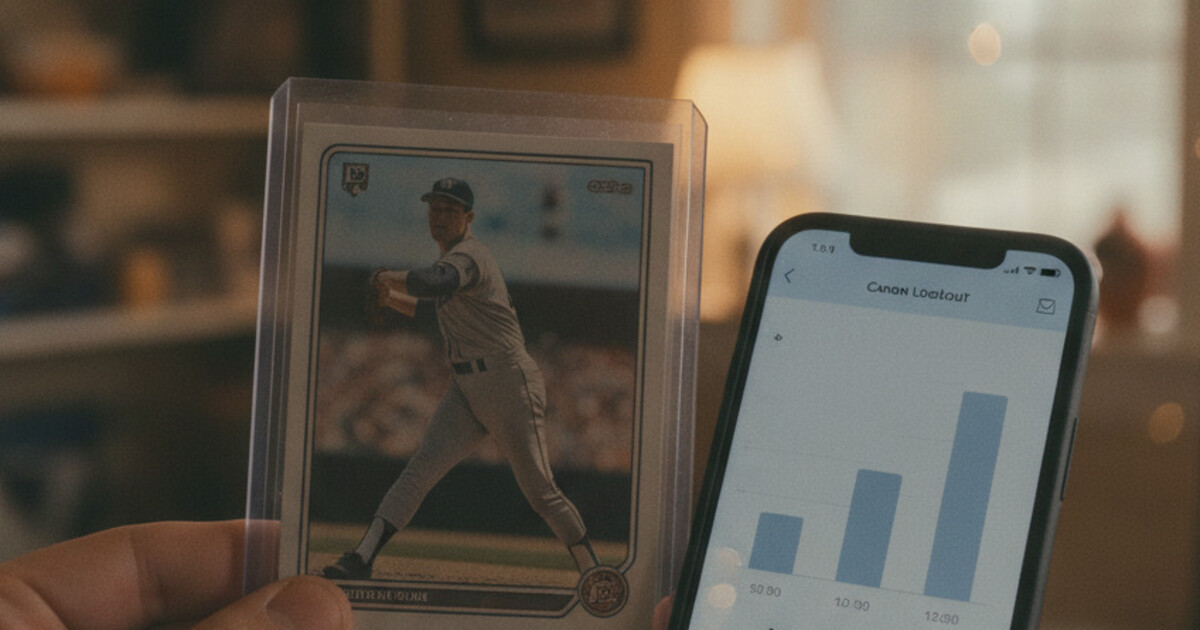
Stakks builds the lookup into the scan itself. Point the camera at a card and the app identifies the player, year, set, parallel type, condition, and card number, then returns a current market value estimate pulled from live sales data.
The result shows a low-to-high price range, a trend indicator (up, stable, or down), and a short market insights note. That range reflects the spread across recent comps at different conditions, not just a single middle number.
For collection tracking, Stakks logs every scanned card and rolls up total portfolio value. If a player’s market moves, the portfolio total updates to current comps rather than showing what you paid at time of scan.
That’s the key thing a one-off lookup misses: a single price check is a snapshot. A running collection with live value tracking shows you the number over time, which is more useful when deciding what to hold and what to move on.
Frequently Asked Questions
How accurate are sports card value lookups?
Accuracy depends on how many recent sales exist for your exact card. Cards with deep market data, like major rookies and popular parallels, have tight estimates. Rare cards with few comps carry wider uncertainty. Treat any lookup as an estimate from recent market activity, not a guaranteed sale price.
Do card value lookups account for condition?
Most scanner-based lookups factor in condition through user input or image assessment. Some simpler price guides return a mid-range estimate without adjusting for condition, which is less useful if your card is significantly above or below average. Check whether the tool you’re using separates graded and raw comps.
How often do sports card prices update in a lookup?
Most tools pull from a rolling window of recent sold data, typically 30 to 90 days. Prices can shift daily for cards tied to active players during a season. A lookup result from a few weeks ago may not reflect a major trade, injury news, or a broader market correction.
Can I look up the value of a graded card?
Yes. Graded card lookups filter by grade level (PSA 10, PSA 9, etc.) because the price difference between grades is significant. A PSA 10 of a popular rookie can sell for 3 to 5 times the PSA 9 comp. Some tools show both graded and raw estimates for comparison.
Why does my card show a different value on different sites?
Different platforms pull from different data sources, use different comp windows, and filter differently. eBay sold data, Beckett, COMC, and PSA’s SMR guide can all return different numbers for the same card. Cross-reference two or three sources for any card you’re planning to buy or sell at a significant price.
If you want a sports card value lookup that handles identification and pricing in one step, Stakks does it from a single scan. Point the camera, get the comp range and market trend, then save the card to track your collection’s total value over time. Download Stakks free at stakks.app.