
Want to know what your cards are worth? Stakks is free.
Some people open a box of their dad’s old baseball cards and find a $40,000 windfall. Others dig through the exact same era and walk away with nothing worth more than a quarter. Sports cards can go up in value over time, but whether yours have depends almost entirely on which cards you’re holding.
The hobby saw a massive surge in interest from 2019 through 2021, with some cards reaching peak prices that surprised even long-time collectors. The market corrected afterward. The collectors who came out ahead were the ones who understood what drove value before prices ran up.
This guide covers which sports cards actually appreciate, what’s behind it, and how to check whether your collection has moved.
Some sports cards do go up in value over time, but most don’t. Cards with real appreciation potential share a few traits: an elite player, a low print run, and premium condition. A 1986 Fleer Michael Jordan rookie went from around $100 in the 1990s to $738,000 in 2021. The specific card matters far more than the hobby overall.
Why Most Sports Cards Haven’t Appreciated
The sports card hobby went through a period collectors call the junk wax era, roughly 1987 to 1994. Manufacturers saw demand spike and responded by printing enormous quantities. Topps, Fleer, Donruss, and Score were each producing hundreds of millions of cards per year. Topps alone printed an estimated 900 million cards in 1991.
The result was supply so far exceeding demand that most of those cards have sat in shoeboxes ever since. A 1989 Ken Griffey Jr. Upper Deck rookie is an iconic card in hobby terms, but finding a clean PSA 9 example worth $1,500–$3,000 puts it squarely in the exception category. The base version in played condition trades for a few dollars. The same player, the same year, the same card, and 10 condition grades separate a collectible from cardboard.
If you’ve got stacks of late-1980s or early-1990s cards, there are a handful of valuable exceptions, but the vast majority haven’t moved in three decades. Our guide on are 1990s sports cards worth anything covers what to actually look for in that era.
Any card printed in high enough quantities will struggle to build value. Supply and demand still governs this market. When millions of copies exist, there’s no scarcity to support price growth.
Which Cards Go Up in Value Over Time
This is where the nuance lives. Cards from specific categories have a real track record of appreciation.
Rookie cards of players who become superstars. The rookie card premium is well-documented. A collector who bought a 2018 Panini Prizm Luka Doncic rookie for $40–60 during his debut season could have sold it for $4,000–$6,000 by 2021. The catch: you’re betting on a career before it plays out. Rookies of players who never quite get there don’t appreciate. Rookies of players who become stars climb sharply and typically recover from market corrections.
Low-print-run numbered cards. When a card is printed in runs of 50, 25, or 10 copies, the supply is fixed permanently. As copies get graded, lost, or held long-term, the number available to buyers only shrinks. Serial numbered cards in the /50-to-/1 range from premium sets have shown consistent price floors even for players whose careers leveled off.
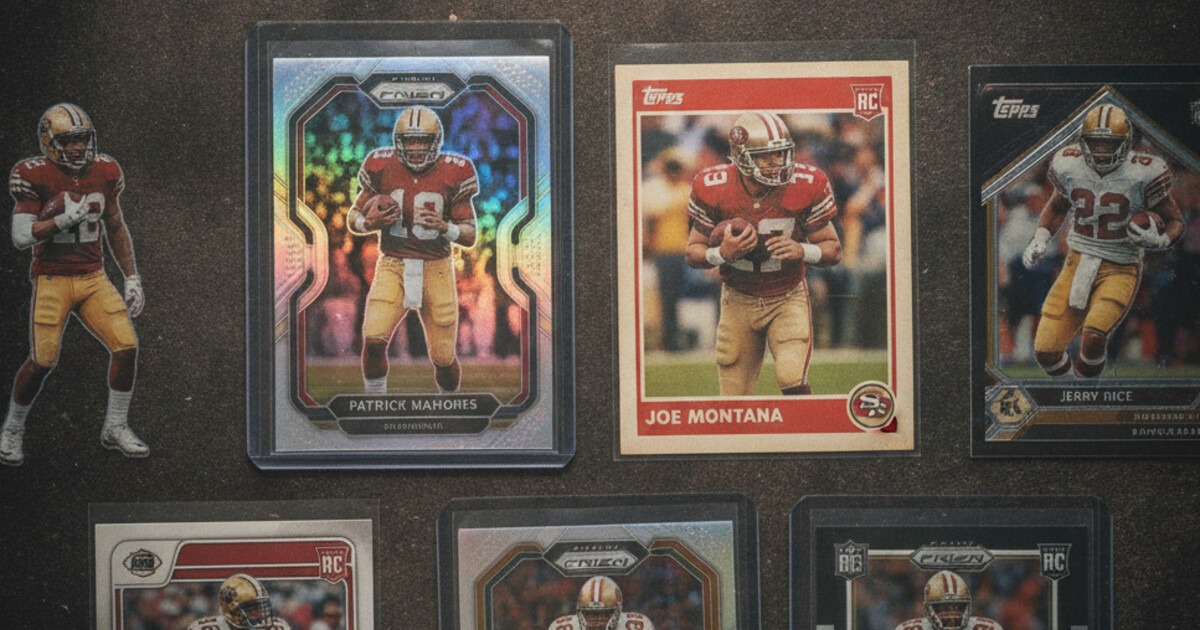
Certified on-card autographs from premium products. Not sticker autos slapped on base cards. On-card signatures from Topps Finest, Bowman Chrome, and National Treasures have held and grown value for top players. Patrick Mahomes’s 2017 National Treasures rookie patch auto sold at 1/1 for $4.3 million in 2023. Even base on-card autos from that product have ranged $5,000–$50,000 for common /99 copies of star players.
Vintage cards with structural scarcity. Cards printed before 1975 had small production runs, poor storage conditions, and decades of attrition. High-grade examples get rarer every year. A 1952 Topps Mickey Mantle in PSA 9 sold for $12.6 million in 2022. Vintage scarcity is structural because supply can only decrease.
Sports card appreciation depends on the intersection of scarcity, player quality, condition, and demand. Cards from the modern era (1999–present) that have appreciated most reliably share a formula: rookie year of a future star, premium product with low print runs, and high condition grade. A 2018 Panini Prizm Luka Doncic rookie in raw near-mint condition sold for around $40–60 during his debut season. By 2021, PSA 10 copies peaked at $4,000–$6,000, roughly a 50–100x gain in 3 years. Conversely, a 1991 Topps Stadium Club Brett Favre rookie card has traded in the $3–$8 range for most of its existence because millions were printed. The print run tells the story: a card numbered /25 has exactly 25 copies in the world. That supply never increases. As condition copies are graded, lost, or held, available supply only shrinks. That structural scarcity is what separates cards that appreciate from cards that don’t.
What Drives Long-Term Card Appreciation
Several forces move card values over years or decades.
Player performance. No single factor moves card prices faster. A player winning MVP, a championship, or breaking a record typically produces a 30–200% price jump on their most desirable cards within weeks. Injuries and slumps work the opposite direction. Card values track careers closely.
Condition over time. Cards degrade. Corners wear, surfaces scratch, edges chip. A card stored flat in a hard case since 1998 has held its condition. One that spent years loose in a shoebox hasn’t. The surviving high-grade examples of any desirable card get rarer each year, which supports price floors for clean copies. Understanding what makes a sports card rare is essential before evaluating any card’s long-term potential.
Market cycles. The card market ran hard from 2020 to 2021. Pandemic-era nostalgia combined with extra spending and social media hype pushed many cards to prices that didn’t hold. Cards with strong fundamentals (top players, low print runs, high grades) recovered. Cards that rode pure hype without those fundamentals didn’t. Timing the card market is as hard as timing stocks. Long-term holds on genuine scarcity tend to outperform speculation.
Set prestige. Bowman Chrome first-year prospects carry premiums over the same players in base Topps because the hobby has decided that Bowman Chrome is the definitive prospect card. Panini Prizm carries the same authority in basketball and football. That perception is sticky and generally holds through corrections.
Chrome vs. paper. Modern chrome-technology cards grade better, hold condition longer, and carry higher appreciation ceilings than their paper counterparts. A Topps Chrome Rafael Devers base card trades for $8–25 raw. The same player on paper Topps Series 1 trades for $1–4. The production technology matters beyond just collecting preference.
How to Check If Your Cards Have Gone Up in Value
You can dig through eBay sold listings manually, filtering by card, year, set, condition, and parallel type. Done correctly, it takes 10–20 minutes per card. Done incorrectly, you’ll compare the wrong version and get a bad number.
The faster option is scanning with Stakks. Point your camera at the card and Stakks identifies the player, year, set, brand, card number, rarity, and condition. It then shows the current estimated market value with a low price and high price range, plus a trend indicator showing whether prices are moving up, down, or holding flat.
Scan history keeps a log of every card you’ve checked, so you can revisit and see how values have shifted over time. If you’ve got a collection you haven’t valued in a few years, working through it with Stakks is the quickest way to find out what’s moved and what hasn’t.
For a deeper look at how market data gets built into a price estimate, read our guide on how to find what your card is worth.
Frequently Asked Questions
Do sports cards increase in value over time?
Some sports cards do increase significantly in value, especially rookie cards of star players, low-print-run numbered cards, and certified autographs. But most cards, particularly those from the overproduction era of 1987–1994, have held little to no value for decades. The specific card matters far more than the hobby overall.
What types of sports cards appreciate the most?
Cards that tend to appreciate include rookie cards of players who go on to star careers, cards with print runs under 100, certified on-card autographs, and chrome-based parallels from premium sets. Cards of players who win championships or break records often see sharp short-term spikes in value.
How long does it take for sports cards to go up in value?
There’s no set timeline. A rookie card can spike within weeks of a breakout game or MVP award. Vintage cards from the 1950s–1970s appreciate steadily over years as supply dwindles. Cards from the junk wax era (1987–1994) have largely stayed flat for 30+ years because supply is still far too high.
Is buying sports cards a good investment?
Sports cards can be a good investment if you focus on the right cards: low print runs, top players, premium condition. But they’re illiquid, uninsured, and unpredictable. Most collectors treat cards as a hobby first and an investment second. The collectors who profit most are usually the ones who know the hobby deeply.
How can I check if my sports cards have gone up in value?
Scan your cards with the Stakks app to see current market value estimates based on recent sales data. Each card shows a low price, high price, and trend indicator so you can see whether prices are moving up, down, or holding steady.
Scan your collection with Stakks to see current estimated values, trend indicators, and price ranges for every card. Whether you’re checking a shoebox of childhood cards or a collection you’ve been building for years, a quick scan tells you where things stand today.