
Want to know what your cards are worth? Stakks is free.
You pull a card from a pack, or you dig one out of a shoebox from the 90s. It could be worth $5 or $500, and the cardboard in your hand has no label telling you which. The graded vs raw cards question comes up fast once you start collecting seriously: what’s the difference, and does getting a card graded actually change what it’s worth?
The short answer is yes, often by a wide margin. A PSA 10 rookie can sell for 3 to 8 times what the same card brings raw. Whether grading makes sense on a specific card depends on what it is, what condition it’s in, and what grading costs you.
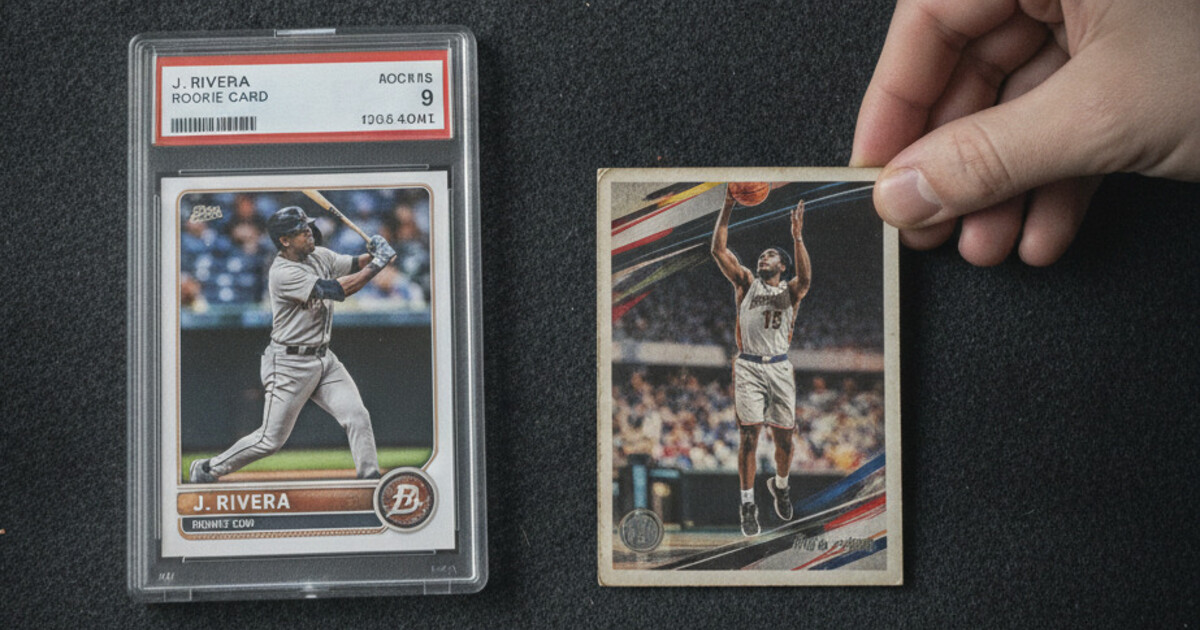
A raw card is any ungraded card. A graded card has been authenticated, assessed for condition, and sealed in a tamper-proof plastic case with a numeric score from a grading service like PSA, BGS, or SGC. Graded cards typically sell for more because buyers know exactly what they’re getting: verified authenticity and a standardized condition score.
What Is a Raw Card?
Raw means ungraded. If a card came out of a pack and you’re holding it (in a sleeve, a toploader, or just loose in a box), it’s raw.
Most cards in existence are raw. The vast majority of cards pulled from packs every year never get submitted to a grading service. They live in binders, shoeboxes, and card boxes across the country.
Raw cards aren’t necessarily low-value cards. Many collectors prefer buying raw, especially for set building or budget collecting. The problem is that condition is self-assessed by whoever is selling. One person’s “near mint” is another person’s “beat up,” and that gap creates a lot of disputes in the hobby.
A raw card’s value comes from the same factors as any card: the player, the year, the set, the card type, and the condition. Condition is where raw cards get unpredictable. A corner ding you can barely see in listing photos can knock serious money off the price when someone inspects it in person. For a deeper look at what drives value beyond condition, check our guide on what makes a sports card rare.
What Is a Graded Card?
A graded card has been submitted to a professional grading service (PSA, BGS, or SGC are the main three), authenticated, and assigned a numeric grade on a 1-10 scale. The card gets sealed in a clear plastic case called a slab.
The slab shows the grade on the label, along with the card’s identification details. PSA grades from 1 (Poor) to 10 (Gem Mint). BGS uses half-point grades and adds four subgrades (centering, corners, edges, surface). SGC grades on a similar scale and is especially popular for vintage cards.
The price gap between a PSA 10 and a PSA 8 of the same card is often dramatic. A 2018-19 Panini Prizm base Luka Doncic in PSA 10 sells in the $600-2,000 range depending on market timing. The same card in PSA 8 typically trades for $80-200. The raw version in excellent condition sits around $30-100. That means a PSA 10 can sell for 10-20 times what a sharp raw copy brings. The premium exists because a PSA 10 is extremely rare: fewer than 10-15% of submitted high-series cards achieve Gem Mint status. Buyers pay for certainty. They know the card is authentic, the exact condition is documented, and the slab protects it going forward. For a card that might be worth thousands in top grade, the grading fee ($25-$150 per card depending on the tier) is a small insurance premium against condition disputes. The downside: graded cards cost more to buy, and if you submit a raw card that grades lower than expected, you can take a meaningful loss after fees.
When Grading Changes the Price (and When It Doesn’t)
Grading doesn’t automatically add value. For most cards, it breaks even at best.
The practical math: if a card is worth $10 raw and PSA charges $25 to grade it, it needs to come back a 9 or 10 to turn a profit. A PSA 8 on that card and you’re underwater on the submission. That’s why collectors only grade cards where the upside is meaningful enough to justify the cost and the wait.
Cards that typically make sense to grade:
- High-value rookie cards (worth $100+ raw, where a PSA 10 could push $500 or more)
- Vintage cards (pre-1980) where grading authenticates age and condition
- Key autographs or low-numbered cards where authentication matters to buyers
- Cards you plan to sell to an audience that expects condition certainty
Cards that usually don’t justify grading:
- Anything worth under $50 raw
- Junk wax era cards (late 1980s through early 1990s) where supply is enormous
- Base cards from modern high-volume sets where even a PSA 10 doesn’t command much of a premium
For a full breakdown of what determines card value in the first place, our guide on what your sports card is worth covers the key factors.
How to Assess a Raw Card Before Deciding
Before you send anything to a grading service, you need an honest read on the card’s condition.
The four grading criteria are centering, corners, edges, and surface. Centering refers to how well the image sits within the border: PSA 10 typically requires 55/45 or better on both front and back axes. Corners need to be sharp with no fraying. Edges should be clean with no nicks or chips. The surface should be free from scratches, print lines, and sticker residue.
Scan the card with Stakks to get an estimated market value based on recent sales. The app shows a condition field alongside the price data, giving you a baseline for the grading math. Compare the raw estimated value against the grading fee and the grade you realistically expect to see whether submitting makes sense.
Be honest with yourself on condition. Most collectors overgrade their own cards by half a point to a full point. What looks like a PSA 9 to the naked eye often comes back an 8 once the graders run their calipers across it.
Graded vs Raw Cards: Which Should You Buy?
Buying graded costs more upfront but eliminates condition risk. You know exactly what you’re getting. For higher-value cards, that certainty is worth paying for, especially on purchases from sellers you don’t know.
Buying raw is cheaper but requires trusting your own eye or the seller’s description. Raw makes sense for set building, budget collecting, and cards where the grading fee exceeds any realistic upside.
A practical middle ground: buy raw, assess the condition honestly, then grade the cards that look like strong candidates. Many collectors do a pre-grade check before submitting, looking for the disqualifying flaws (creases, heavy scratches, severe miscut centering) that guarantee a low grade regardless of how clean the card looks at first glance.
Condition grades don’t exist in a vacuum. A PSA 8 of a common base card isn’t worth much more than raw. A PSA 8 of a 1986 Fleer Michael Jordan, on the other hand, trades for thousands, because the player and the era make even a mid-grade copy valuable.
Frequently Asked Questions
Can Stakks look up a card’s PSA or BGS grade?
Stakks shows an estimated market value from recent sales data and a condition field from the scan, but doesn’t connect to PSA, BGS, or SGC to pull official grade information. For an official grade lookup on a slabbed card, check the grading service’s website directly using the certification number on the slab label.
Is it worth grading sports cards?
For most cards, grading doesn’t pay off once you account for fees and turnaround time. Cards worth grading generally have a raw value above $50-100 with a realistic shot at a PSA 9 or 10. Low-value cards and junk wax era cards rarely justify the cost.
What does PSA 10 mean?
PSA 10 is Gem Mint condition, PSA’s highest grade. The card has to be virtually perfect across centering, corners, edges, and surface. Fewer than 10-15% of submitted cards typically achieve this, which is why PSA 10s command a premium over PSA 9s for most in-demand cards.
How much does card grading cost?
PSA’s economy tier runs around $25 per card, the value tier around $50, and express services go up to $150 or more per card. BGS and SGC have similar tiered pricing. Turnaround time ranges from a few weeks to several months depending on the tier you select.
Should I grade a rookie card?
Only if the rookie has meaningful raw value and a realistic shot at a high grade. A base rookie worth $5 raw won’t pay off in PSA 10 once fees are factored in. High-profile rookies with strong collector demand, or vintage RCs of stars from earlier eras, are the better grading candidates.
Scan First, Then Decide
Before you send anything off to a grading service, know what the raw version is actually worth. Scan your cards with Stakks to see an estimated market value from recent sales, the price range, and the trend. With a realistic baseline for the ungraded card, you can do the grading math quickly: if a PSA 10 of that card typically brings 4-5x the raw price and the submission fee is $50, you know in seconds whether it makes sense to submit.