
Want to know what your cards are worth? Stakks is free.
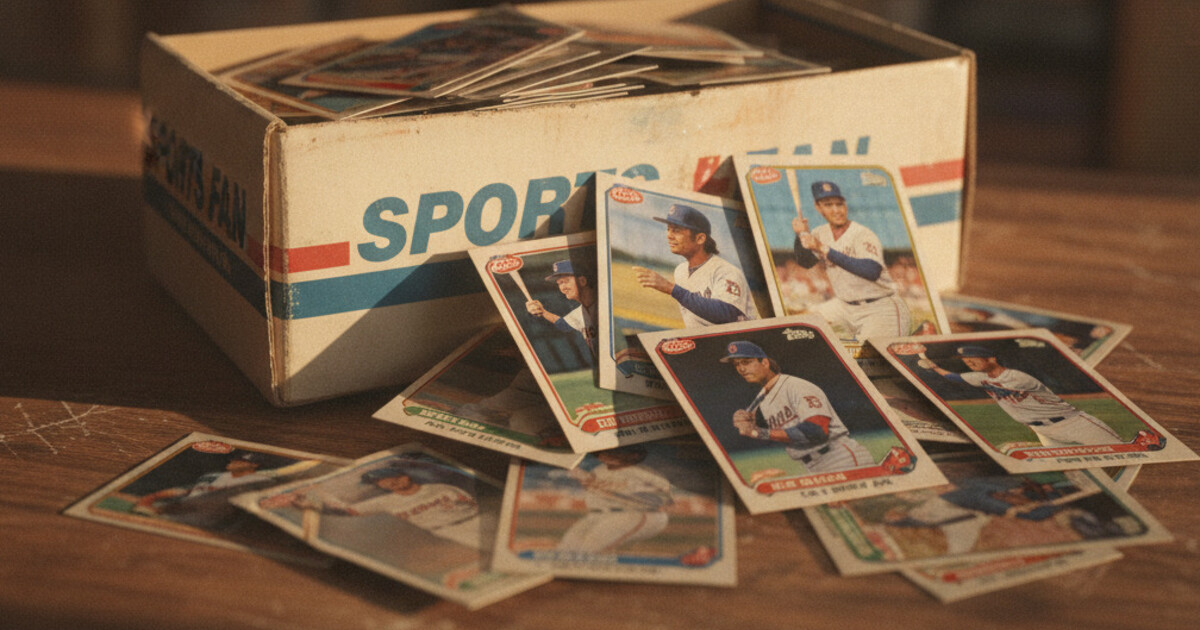
Found a box of old baseball cards in the closet? Before you start imagining a windfall, you need one piece of context: most cards from the 1980s and 1990s are worth very little. But some cards from that same era, and especially from earlier decades, are genuinely valuable. The difference comes down to a few specific factors, and once you know them, you can sort a mixed collection in minutes rather than hours.
Old baseball cards are worth money when three factors line up: a major star player, pre-1980 production (smaller print runs, fewer surviving copies), and near-mint condition. Cards from the junk wax era (1987-1993) are usually worth $0.05-$0.50 regardless of the player. The exceptions are rookie cards of confirmed stars in excellent shape.
Why Most Old Baseball Cards Aren’t Worth Much
The period between 1987 and 1993 is called the junk wax era, and the name explains itself. Topps, Donruss, Fleer, Score, and Upper Deck were all printing simultaneously to meet surging speculator demand. Topps printed more than 900 million cards in peak years.
That volume killed scarcity. A 1990 Donruss Ken Griffey Jr. might feel exciting to find, but tens of millions of that exact card exist. On eBay today, they sell for $0.10-$0.50 in played condition. Complete sets from this era often sell for $10-$30 total despite containing hundreds of cards.
The junk wax era wound down around 1994-1995. Manufacturers pulled back print runs and introduced serial-numbered parallels and premium inserts. Cards printed after that point are a different conversation.
How to Tell If an Old Baseball Card Is Worth Money
Four factors determine value, and they stack on each other.
Player. This is the single largest filter. Hall of Famers, franchise players, and players who defined their era command significantly higher prices than bench players and journeymen. A 1984 Topps Don Mattingly rookie card is worth roughly 50 times more than a 1984 Topps backup infielder’s card. Start your research with the players you recognize as true stars and skip the rest unless something else stands out.
Year and era. Most old baseball cards have little market value, but the reasons are specific. Cards printed between 1987 and 1993, the period collectors call the junk wax era, exist in massive quantities because manufacturers overproduced to meet speculator demand. Topps printed more than 900 million cards annually at the peak, and Donruss, Fleer, and Score competed at the same volume. Most 1990s commons sell for $0.05-$0.50 today. The 1989 Upper Deck set is a notable exception: it was the first year of a premium brand with tighter print controls, and Ken Griffey Jr.’s #1 card now sells for $15-$40 raw and $300-$1,500 in PSA 10 condition. Pre-1980 cards generally fare better because print runs were smaller and fewer copies survived intact. A 1952 Topps Mickey Mantle PSA 9 sold for $12.6 million in 2022. A 1968 Topps Nolan Ryan rookie in near-mint condition currently trades for $1,000-$8,000 depending on grade.
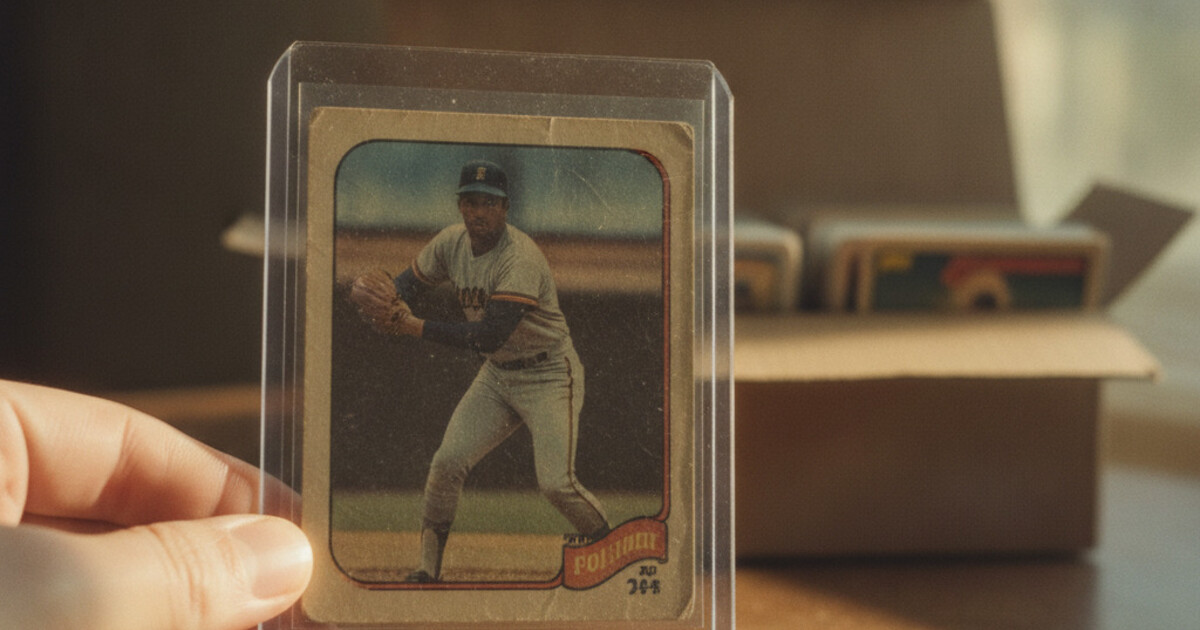
Condition. A single crease, soft corner, or heavy print dot can cut a card’s value by 50% or more. The hobby grades condition on a 1-10 scale, and the premium for top-grade copies is substantial: a PSA 10 copy of a vintage card often sells for 5x to 10x what a raw mid-grade copy fetches. Before pricing any card, assess it honestly. Are the corners sharp or rounded? Is the surface clean? Are the borders centered?
Card type. Rookie cards are worth more than base cards of the same player. Autographed cards carry significant premiums over non-autographed versions. Serial-numbered cards, those stamped with a print run like “12/25” on the card face or back, had limited production by design and are worth checking regardless of year.
Understanding what makes a sports card rare walks through the full rarity framework in detail. Print run, player significance, card type, and condition all layer together to determine final value.
Old Baseball Cards That Are Actually Worth Checking
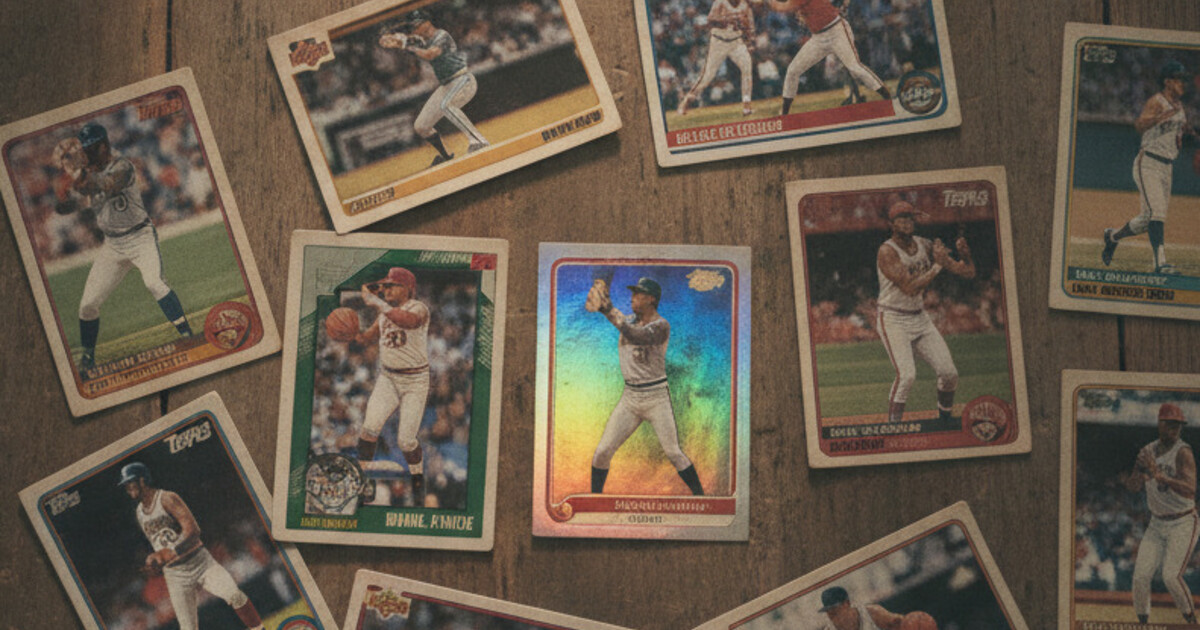
Not every card in a mixed collection deserves deep research. Focus on these categories first.
Pre-1980 Hall of Famers. Mickey Mantle, Willie Mays, Hank Aaron, Roberto Clemente, Sandy Koufax. Any card in played-but-intact condition is worth pricing. Rookie cards of these players in good shape sell for hundreds to thousands of dollars depending on the specific year and set.
The 1989 Upper Deck set. Upper Deck’s debut year used higher-quality cardstock and tighter print controls than contemporary Topps sets. Ken Griffey Jr.’s #1 card from this set is the centerpiece of the hobby’s modern era. Raw near-mint copies sell for $40-$100, and graded PSA 10 copies have sold for $1,500+.
Pre-1994 rookie cards of confirmed stars. Frank Thomas (1990 Leaf #220), Cal Ripken Jr. (1982 Topps #21), Barry Bonds (1987 Topps #320), Roger Clemens (1984 Donruss). These players became Hall of Famers or franchise cornerstones, and their earliest cards hold value even from the junk wax era when condition is close to mint. The key word is near-mint: the same cards in heavy play condition are worth a fraction of the price.
Anything serial-numbered. If you see a print run stamped on the card, such as “47/99” or “1/1,” look it up. Even junk wax era numbered parallels often carry genuine value because of limited production.
Oddball and regional issues. Cards from Kellogg’s, Hostess, Drake’s, or other food-promotion sets exist in far fewer quantities than retail Topps and Donruss sets. They’re harder to identify but frequently undervalued in general searches.
How to Check the Value of Old Baseball Cards
Once you’ve identified the cards worth pricing, you need current market data, not a price guide printed a decade ago.
eBay sold listings. Go to eBay and search for the exact card: player name, year, set name, and card number. Filter by “Sold” listings only, not active listings. What you see is what buyers actually paid. Sort by newest first and focus on the last 90 days. Card markets move constantly, and stale sales mislead.
Card scanner apps. Point your phone at the card and Stakks identifies the player, year, set, and variation automatically, then returns a market value estimate from real recent sales. It shows a low and high price range reflecting real variance based on condition and recent transactions. Much faster than manual eBay searches when you’re sorting through a large stack.
Condition adjustment. Whatever price you find, discount it if your card has any visible wear. A card with a soft corner or slight crease is worth 30-50% less than a near-mint copy of the same card. If the card looks like it came straight from a fresh pack with sharp corners and a clean surface, you’re at the high end of the range.
The full step-by-step valuation process is covered in how to find the value of a baseball card, including how to use eBay efficiently and when the extra sources like COMC and auction house records are worth checking.
What Condition Your Cards Are Actually In
Most cards from shoeboxes and closets grade between Poor and Good. That’s the honest reality for the majority of inherited collections. A card that looks fine casually might have rounded corners or a slight bow that knocks it down two full grades in the hobby’s official scale.
Check four things: corners (sharp or soft?), surface (any scratches or print dots?), centering (borders even or shifted to one side?), and edges (any chips or nicks?). All four need to be close to perfect for a vintage card to grade well professionally.
Cards in played condition still carry value for the right players. A 1963 Pete Rose rookie in Good condition sells for $200+. A 1952 Topps Mantle in that same condition sells for $5,000+. The value reduction from condition is relative to the base value, not an absolute cut.
For cards potentially worth $200 or more raw, professional grading from PSA or BGS is worth investigating. For cards in the $10-$50 range, grading fees typically cancel out any premium the grade would add. The full math on this decision is at graded vs raw cards.
Frequently Asked Questions
How do I know if my old baseball cards are worth money?
Check three things first: the player (Hall of Famers and stars hold the highest value floor), the year (pre-1980 cards generally hold value better), and the condition. Cards from 1987-1993 are usually worth less than $0.50 unless they’re rookie cards of major stars in near-mint condition.
Are 1980s and 1990s baseball cards worth anything?
Most aren’t. Cards from the junk wax era (1987-1993) sell for $0.05-$0.50 each because manufacturers printed hundreds of millions of them. Exceptions include rookie cards of confirmed stars like Ken Griffey Jr., Frank Thomas, or Cal Ripken Jr. in near-mint condition, which can sell for $20-$300+.
What old baseball cards are most valuable?
Pre-1970 rookie cards of Hall of Famers in good condition are most valuable. Key targets include the 1952 Topps Mickey Mantle, 1963 Topps Pete Rose RC, 1968 Topps Nolan Ryan RC, and 1989 Upper Deck Ken Griffey Jr. #1. Autograph cards and serial-numbered parallels from any era command significant premiums.
Does condition really matter that much for old card values?
Yes, dramatically. A 1989 Upper Deck Ken Griffey Jr. in raw played condition sells for $15-$40. The same card graded PSA 10 can fetch $300-$1,500. A single crease or soft corner can cut a card’s value by 50% or more.
Can I check old baseball card values without doing eBay research myself?
Yes. Download Stakks, point your phone at the card, and it identifies the player, year, set, and variation automatically, then shows a current market value estimate from real recent sales. Faster than sorting through eBay sold listings one card at a time.
If you’ve got a shoebox of old baseball cards and want to know what you’re actually holding, Stakks handles the research fast. Point your camera at each card and it identifies it instantly: player, year, set, and variation. Then it shows a market value estimate pulled from real recent sales data. Download Stakks free on iOS and Android at stakks.app.