
Want to know what your cards are worth? Stakks is free.
You cracked open a pack and pulled a card that looks almost like a base card (same player, same photo) but the border is gold, or there’s a rainbow foil finish, or there’s a small “/99” stamped in the corner. That’s a parallel card. Understanding what you’re holding can be the difference between tossing it in a common box and realizing it’s worth serious money.
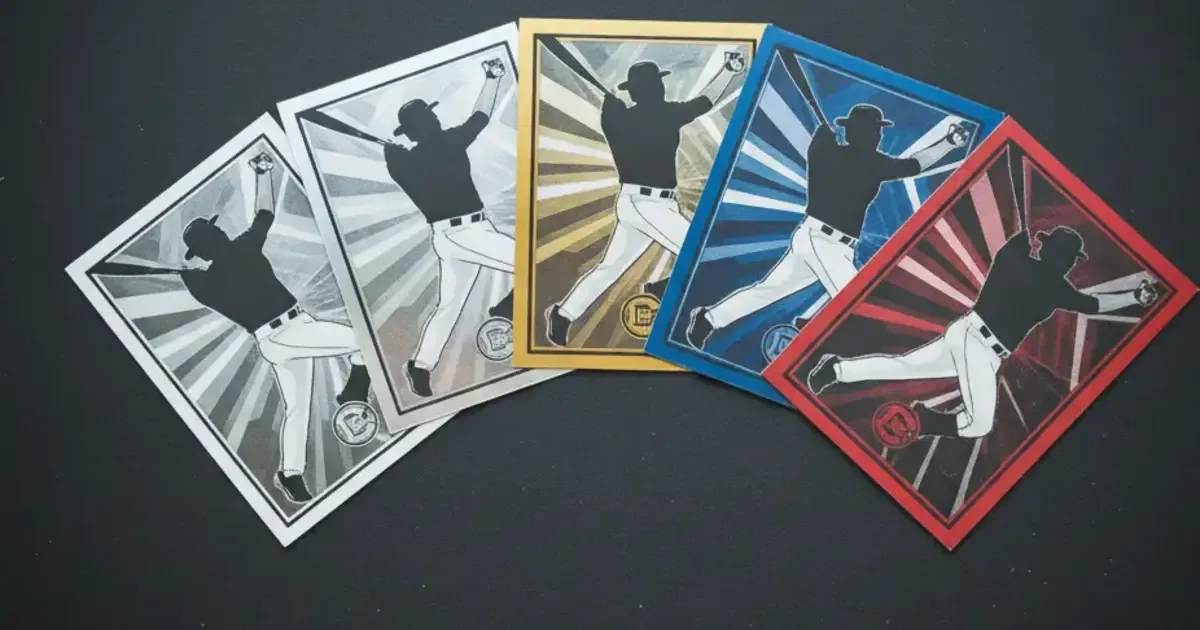
A parallel card is an alternate version of a base card from the same set, printed with a different color, foil, or finish to distinguish it. Parallels almost always have smaller print runs than the base card, which makes them rarer and more valuable. The fewer copies printed, the higher the parallel typically sells for.
What Makes a Card a Parallel?
A parallel shares the same design and photo as its base card but gets a distinct visual treatment: colored borders, chromium foil, a special background, or a unique finish. Card manufacturers like Topps, Panini, and Bowman build parallel “tiers” into every set, so each base card gets multiple versions printed in decreasing quantities.
The key mechanic is print run scarcity. A typical Topps Series 1 base card has no stated print run (thousands exist). A Blue parallel might be numbered to /299. The Gold is /50. The Red is /10. The 1/1 Superfractor sits at the top. Each step up the tier ladder means fewer cards exist, and prices jump sharply.
This tiered structure is how modern card sets create a chase system. Collectors crack packs hoping to pull parallels instead of base cards, because even a low-tier parallel of a star player can be worth multiples of the base.
Manufacturers introduced color-coded parallels in the early 1990s, but Topps Chrome refractors (debuted 1996) made the format mainstream. Today, most major sets include anywhere from 8 to 20 distinct parallel tiers per base card. The value difference between tiers can be dramatic: a Luka Doncic Prizm base card might sell for $8-12, while a Pink parallel numbered /49 of the same card sells for $200-400, and a Gold Prizm 1/1 has sold for over $4,000. Scarcity drives most of that spread. Player performance, condition, and timing add more variables, but print run is the foundation every collector needs to understand before evaluating any parallel. Card manufacturers design these tiers to create a pull-rate hierarchy inside every pack: most packs yield base cards, while lower-numbered parallels are seeded at rates as low as one per box or one per case. That controlled scarcity is what keeps secondary market prices elevated for the rarest tiers.
The Most Common Types of Parallel Cards
Parallels come in several formats. Here’s what you’ll run into most often.
Color-bordered parallels are the most common type. The base card has a white or gray border; the parallel swaps it for Blue, Red, Gold, or another color. Each color corresponds to a different print run. Gold usually means /50, Red often means /10, but it varies by brand and set. Always check the print run number stamped on the card rather than assuming based on color alone.
Refractors and Prizms use chromium foil technology that makes the card’s surface shimmer and scatter light into a rainbow pattern. Topps Chrome refractors and Panini Prizm are the two most recognizable examples. Prizm parallels (Silver, Gold, Pink, Purple, and many others) drive some of the highest sales in the modern hobby. A base silver Prizm is technically an unnumbered parallel of the standard Prizm card.
Numbered parallels have a serial number stamped directly on the front or back: “47/99” means that card is copy 47 out of 99 printed. The lower the print run, the rarer the card. Anything numbered /25 or fewer is considered genuinely scarce by collector standards. Under /10 and you’re in territory that sells at significant multiples of the base price, even for average players.
1/1 cards (one-of-ones) sit at the top. Only one exists in the world. They go by different names depending on the brand: Superfractor (Topps Chrome), Black (Panini Prizm), and Printing Plate (various brands; four exist per card, one per printing color).
Die-cut and specialty parallels use unusual shapes or textures beyond the standard rectangle. Less common, but they show up in certain premium sets and can carry strong collector interest when the player is right.
What Is a Parallel Card Worth?
Four factors determine most of the price.
Print run is the biggest one. A /299 Blue parallel of a mid-tier player might trade at $3-8. The same player’s Gold /50 could be $30-60. The Red /10 might hit $150. The pattern holds across most sets: each step down in print run roughly multiplies the value.
Player popularity and performance move prices fast. A parallel of an established star holds its value well. A parallel of a breakout rookie or a player who just won a championship can spike overnight. The reverse happens just as quickly: underperformance, trades, or injuries push values down.
Condition matters at every price point. Centering problems, surface scratches, or corner wear cut into value. Professionally graded parallels (PSA, BGS, SGC) command premiums over raw copies when the grade is strong, particularly for cards numbered /25 or fewer.
Set prestige adds another layer. A parallel from Topps Chrome, Panini Prizm, or Bowman Chrome carries stronger collector demand than a parallel from a budget retail set. Brand recognition drives liquidity, meaning it’s easier to sell a Prizm parallel than a parallel from a lesser-known product.
For a broader look at the factors that push any card’s value up or down, see the guide on how to tell if a sports card is valuable.
Parallels vs. Base Cards: What the Tiers Look Like
To see how a single card fans out across parallel tiers, here’s a typical Topps Chrome structure:
| Tier | Example name | Approx. print run | Relative value vs. base |
|---|---|---|---|
| Base | Standard | Unlimited | 1x |
| Refractor | Refractor | ~500 | 2-4x |
| Color parallel | Blue /199 | 199 | 3-6x |
| Color parallel | Gold /50 | 50 | 8-15x |
| Short-print | Red /10 | 10 | 20-50x |
| One-of-one | Superfractor 1/1 | 1 | 100x+ |
Values shift constantly with player performance and market conditions, but the tier structure stays consistent. The multipliers above are rough ranges: a star player’s /10 can blow past 50x the base while a backup’s /10 might barely move the needle.
How Stakks Identifies Parallel Cards
When you scan a card with Stakks, the app shows the card’s details: player name, sport, team, year, set, brand, card number, rarity, and insert name. For parallels, the rarity and insert name fields are where the key information surfaces, so you can tell whether you’re holding a base card, a /299 parallel, or something rarer.
Parallels can look nearly identical to base cards, especially when the foil or color difference is subtle under certain lighting. Scanning cuts through the guesswork. Stakks shows the estimated market value based on recent sales data, so you see the price range for that specific parallel tier, not just the base card price.
If you’re sorting through a bigger collection, scan everything. The value difference between a base card and a parallel of the same player can be substantial, and it’s not always obvious at a glance. See what is my sports card worth for a practical walkthrough of how card values are determined.
Frequently Asked Questions
Do all sports card sets have parallels?
Most modern sets do. Topps, Panini, and Bowman build parallel tiers into nearly every product they release. Vintage cards from the 1950s through the 1980s generally don’t have parallels. The concept became standard in the 1990s and now defines how modern card products are structured.
How do I find out the print run of a parallel?
Check the card itself first. Most numbered parallels have the print run stamped directly on the front or back (something like “12/99”). Unnumbered parallels like base Prizm or base refractors don’t have a stamped number but are still parallels because of their distinct chromium or color finish. For those, set documentation tells you the approximate print run.
Are parallels worth buying as investments?
Some are, some aren’t. Low-numbered parallels (/25 or fewer) of established stars or breakout rookies tend to hold collector demand. Parallels of speculative players carry more risk. Card prices can fall fast, so buy what you’d be happy to own if the market cools.
What’s the difference between a parallel and an insert?
A parallel is an alternate version of a base card with the same photo but a different color or finish. An insert is a completely separate card design not found in the base set. Both are chase cards pulled from packs, but they’re distinct categories, and both show up in Stakks’ card identification.
Can Stakks tell me if my card is a parallel?
Yes. When you scan a card, Stakks shows the rarity and insert name fields in the card details. If you’ve got a parallel, that information shows up along with the estimated market value for that specific parallel version.
Parallels Are Worth Understanding
Once you know what a parallel is and how the tier system works, you can evaluate any pack pull quickly. Check the border color. Look for a stamped serial number. Check whether the surface has a foil or chromium finish.
When you want the actual value, scan it with Stakks. The app identifies the card’s rarity and pulls estimated market value from recent sales, so you know exactly what you’ve got, base card or rare parallel, without spending time digging through completed listings.