
Want to know what your cards are worth? Stakks is free.
Pull out a stack of old basketball cards and one question hits every time: what’s this actually worth? The answer varies more than you’d expect. A 1991 Fleer Shaquille O’Neal base card is worth about $1. A 2019-20 Panini Prizm Zion Williamson rookie in near-mint condition can sell for $150-$500. The difference comes down to five things almost every time, and knowing those five things is the fastest way to sort your keepers from your commons.
Basketball card values range from a few cents to tens of thousands of dollars, depending on the player, condition, set, and print run. A 1991 Fleer base card is worth under $1. A Prizm rookie of a top pick can hit $200-$2,000. Scan the card to get an instant market estimate.
What Determines How Much Basketball Cards Are Worth
Five variables explain most of the value spread in basketball cards: player, card type, set and era, print run, and condition.
Player is the biggest lever. A LeBron James rookie is worth exponentially more than a role player from the same set. Card values track career performance, so rookies of players who become stars climb over time, while prospect hype cards for busts crash fast after the first season.
Card type sets the floor and ceiling within a player. A base card sits at the bottom of the price ladder. A parallel (same player, different color border or foil) is worth more. A numbered parallel is worth more still. An autograph or relic adds another tier. A numbered auto is often the most valuable card in the set for that player.
Print run tightens or widens supply. Cards numbered /999 are common enough that they barely move the needle over an unnumbered base. Cards numbered /25 or lower can sell for 3x-10x more than their unnumbered counterparts. A 1/1 (printing plate or one-of-one) is a category of its own.
Basketball card values vary by several measurable factors. Player reputation drives the ceiling: a 2003 Topps Chrome LeBron James rookie PSA 10 sold for $840,000 in 2021, while his base version raw sits under $200 today. Set and print run set the floor: a standard base card from Fleer 1991 is worth $0.10-$0.50 because packs were overproduced. Modern Panini Prizm rookies of top picks typically sell between $20 and $300 raw depending on the player’s first season. Cards numbered /25 or lower command 3x-10x premiums over unnumbered versions. Condition collapses value fast: a Zion Williamson Prizm RC drops from roughly $80 (near-mint) to $20 (excellent) for a single crease. Autographed rookie cards of lottery picks run $100-$5,000 depending on the athlete and serial number. All values reflect recent sold listings, not asking prices.
Set and era matter because of scarcity and brand recognition. Panini Prizm and Panini Select are the most collectible modern basketball sets. Cards from the junk wax era (roughly 1988-1994) were printed in such high volume that condition premiums barely exist and most have zero collector demand. For a deeper look at the factors that push certain cards into rare territory, see our guide on what makes a sports card rare.
Which Basketball Cards Are Worth the Most Money
These are the tiers where real value concentrates.
1986-87 Fleer rookies. Michael Jordan’s true rookie card sits in this set. A PSA 10 has sold for over $700,000. Even PSA 7 copies run $10,000-$30,000. Magic Johnson and Charles Barkley rookies from the same set sell in the hundreds to low thousands in top grade.
Modern Prizm and Optic rookie autos. Luka Doncic’s 2018-19 Prizm Silver auto /125 has crossed $100,000. Victor Wembanyama’s 2023-24 Prizm Silver auto commands $3,000-$20,000 depending on the grade. Anthony Edwards, Chet Holmgren, and Paolo Banchero autos track closely with their on-court production each season.
Numbered parallels of current stars. Low-print-run parallels (numbered /25 or lower) of LeBron, Giannis, Steph Curry, and Jayson Tatum regularly sell in the $500-$5,000 range. The grade and print run determine where in that range they land.
Base cards of most players. Worth $0.25-$5. Condition doesn’t move the needle much here because there’s no collector scarcity baked in. This is the realistic value for the vast majority of cards in a shoebox from the ’90s or early 2000s.
If you’ve got numbered cards or autographs to price, the same research method that works for baseball applies here. Our post on how to find the value of a baseball card walks through the five-step eBay sold-listing process in detail.
How to Check What Your Basketball Cards Are Worth
Step 1: Identify the card exactly. You need the player name, year, set name, and card type (base, parallel, auto, relic). The set name appears on the card face or back. If the card is numbered, the print run (e.g., “72/500”) is stamped on the front or back in foil.
Step 2: Search eBay sold listings. Search for the exact card (e.g., “2019-20 Prizm Zion Williamson Silver”), then filter by “Sold Items.” This shows what buyers actually paid, not what sellers are hoping to get. Asking prices are fiction. Sold prices are real.
Step 3: Match your card’s condition to the comps. If your card has corner dings or surface scratches, it’s priced closer to the lowest recent comps. If it came from a pack and looks mint, it’s closer to the top end. A single crease can cut the value by 50-60% on cards worth more than $20.
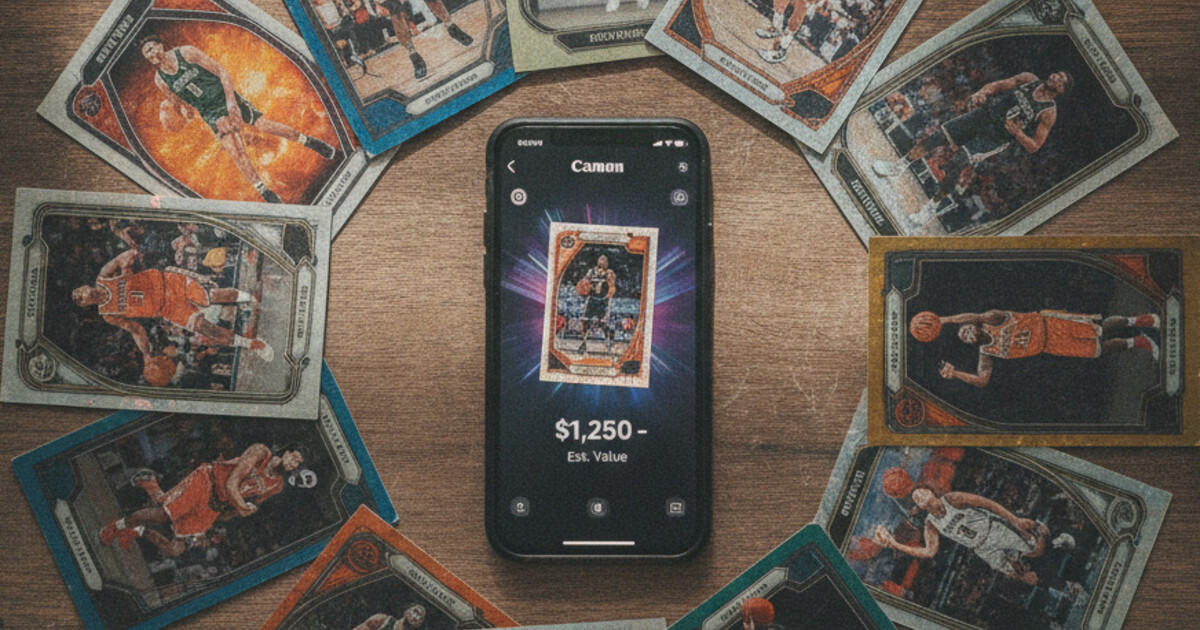
Step 4: Use a card scanner app. A scanner like Stakks handles steps 1 and 2 automatically. You point your phone camera at the card, it identifies the player, set, year, card number, rarity, and card type in seconds, then pulls the current market value with a low price, high price, and trend indicator.
Step 5: Cross-check on COMC or Beckett for cards worth over $100. Both platforms have historical pricing data. For cards in the $100+ range, verifying across two sources before buying or selling is worth the extra few minutes.
How Condition Affects Basketball Card Value
Condition is the variable that can turn a $30 card into a $300 card when everything else is identical.
A Luka Doncic 2018-19 Optic Prizm RC in near-mint condition sells raw for $80-$150. The same card with a crease or heavy corner wear drops to $15-$30. A PSA 10 copy of that card is worth $400-$800 because the certification removes guesswork for buyers who can’t physically inspect the card.
The four main condition killers are: corner wear (fraying or dings on the corners), surface scratches (from sliding against other cards in a binder), centering (the printed image is off-center on the cardboard face), and creases or bends. One serious defect cuts value by 40-60% on anything worth more than $20.
Cards worth grading are the ones where the PSA 10 premium pays for the grading cost several times over. For most commons and low-value cards, grading doesn’t make financial sense. Our graded vs raw cards guide breaks down when submission math actually works in your favor.
How Stakks Helps You Value Basketball Cards Fast
Stakks is built for exactly this situation: you’ve got cards, you want to know what they are and what they’re worth.
Open the app, point your camera at any card, and Stakks reads the player name, sport, team, year, set name, card number, rarity, insert name, and card type automatically. It then pulls a live market value with a low estimate, a high estimate, and a trend indicator showing whether prices are moving up, down, or holding steady.
You can add cards to named collections as you scan. Stakks calculates your total collection value in real time as you go. If you’re sorting through a shoebox, that running total is the fastest way to figure out whether you’re sitting on $80 or $8,000.
Stakks is free to start. Download it on iOS or Android and scan your first basketball card in under a minute.
Frequently Asked Questions
Are 1990s basketball cards worth anything?
Most aren’t. The hobby was overproduced during the junk wax era (roughly 1988-1994), flooding the market with cards collectors still can’t sell decades later. Exceptions exist: a Michael Jordan 1986-87 Fleer PSA 10 is worth six figures, and any Jordan from the late ’80s commands a premium. For everything else from that era, check recent sold listings before assuming the card has value.
What is the most valuable basketball card ever sold?
A 2003-04 Upper Deck Exquisite LeBron James rookie autograph numbered /99 sold for $5.2 million in 2021. Michael Jordan cards hold multiple high-value records. Single-of-ones (printing plates and 1/1 cards) from modern sets routinely clear $10,000 when they feature active superstars.
How much are basketball rookie cards worth?
Rookie card values depend on the player and set. Base rookies of role players sell for $1-$5. Base rookies of top picks range from $10-$50 raw. Prizm or Optic rookies of lottery picks run $50-$500 raw. Add an autograph and that range climbs to $200-$5,000. Condition tightens all of these ranges significantly.
Do basketball cards go up in value over time?
Some do, most don’t. Cards tied to Hall of Fame-caliber players generally appreciate over decades. Cards of players who flame out lose value fast after the hype cools. Short-run autos and inserts from proven superstars hold value better than base parallels. Buy cards you’d want to keep even if they never gained a dollar in value.
How do I check my basketball card values for free?
Search eBay’s sold listings for the exact card (player name + year + set + card type). Filter to “Sold Items” to see real transaction prices instead of asking prices. Free scanner apps like Stakks can also identify and price a card in seconds by scanning it with your phone camera.