
Want to know what your cards are worth? Stakks is free.
Most collectors know which cards they care about. What they don’t know is what everything adds up to. A shoebox from 2020 could hold $200 or $20,000, and without scanning or logging each card, there’s no way to know. Tracking your sports card portfolio value isn’t just something serious investors do. It tells you what to protect, what’s worth selling, and whether your collection is worth insuring. It also catches when a card’s price spikes before you’d otherwise notice.
This guide covers how to track sports card portfolio value whether you have 50 cards or 5,000.
To track your sports card portfolio value, scan each card into a collection app that logs individual market estimates and totals them automatically. Stakks handles this in one step: scan the card, it identifies the player, set, and year, then pulls a live price estimate. For your most valuable cards, check prices monthly. For volatile rookie and numbered cards, check weekly.
Why Tracking Your Portfolio Value Matters
Most collectors add cards without ever stepping back to look at the full picture. Tracking fixes that.
When you know what each card is worth, you can protect the right ones. A penny sleeve and toploader cost about $0.02 combined and make sense for a $2 card. For a $500 card, they’re not optional. Without knowing which cards in your collection have climbed in value, you might be storing a $400 card the same way you store a $0.25 common.
Portfolio tracking also drives smarter decisions about selling. If your Wander Rodriguez Prizm base has climbed from $8 to $25 in six months, that’s worth knowing. If your stack of 1991 Topps has sat at $0.10 per card for three years, that’s worth knowing too.
Sports card portfolio values are more volatile than most collectors expect. The PWCC 100 index, which tracks the 100 most-traded cards by market cap, gained over 200% from early 2020 to its peak in mid-2021, then dropped roughly 35-40% by late 2023 as the pandemic hobby surge cooled. Individual cards moved even more dramatically within those swings. A Luka Doncic 2018-19 Panini Prizm base PSA 10 traded around $500 in early 2020, peaked above $4,000 in 2021, and settled in the $1,500-$2,500 range by 2024. A raw copy of the same card with surface scratches might bring $80-$120. Collectors who tracked these price points could sell near the peak or buy during the correction. Collectors who didn’t track anything held cards at the wrong prices, often selling too early or holding too long. Regular portfolio tracking gives you the same market awareness that active dealers use.
How to Set Up a Sports Card Portfolio Tracker
Stakks handles the core setup in 3 steps.
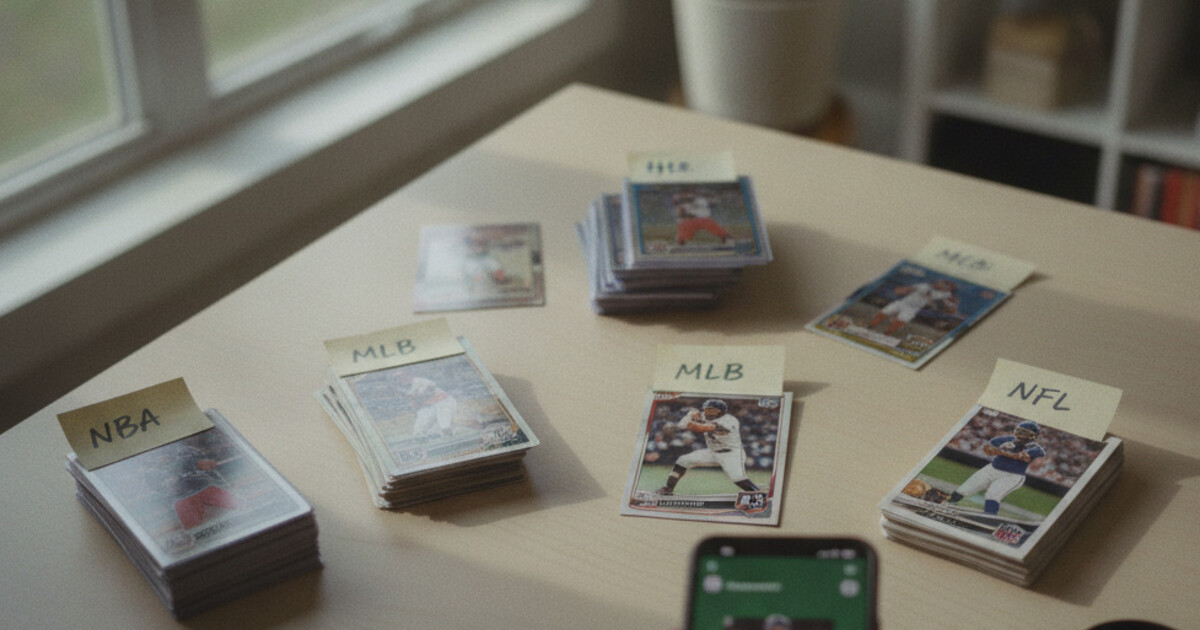
First, create a named collection. You can build separate ones for different sports, players, or value tiers. Some examples: “Basketball rookies,” “Baseball vintage,” “Numbered cards /99 and under.” Named collections let you see the total value for each group separately.
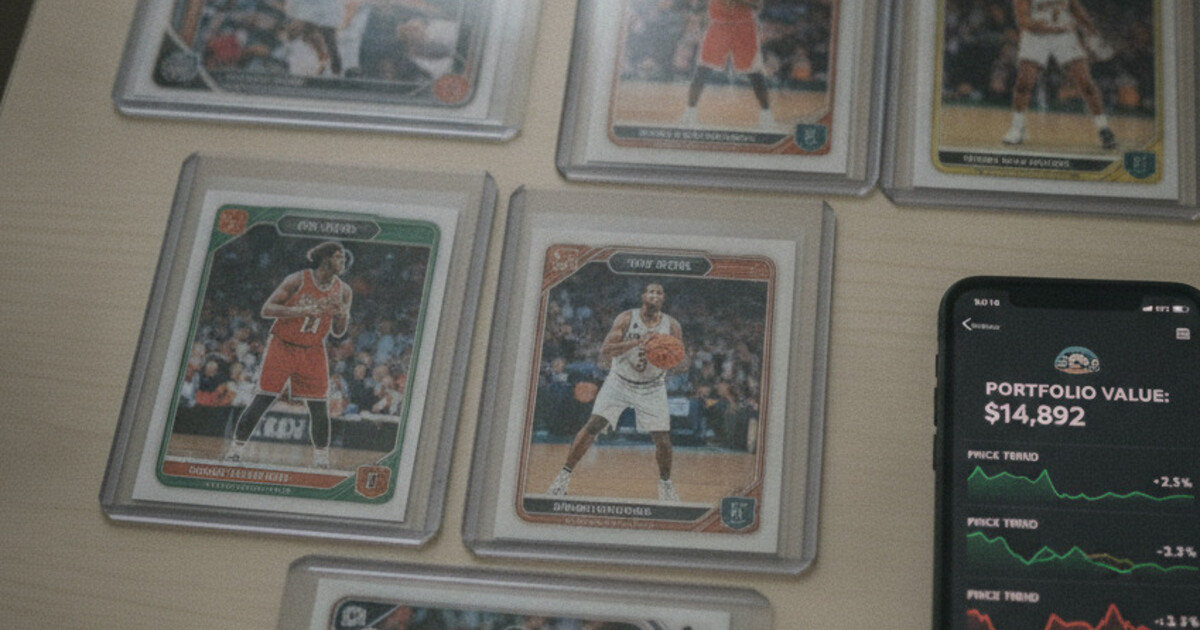
Second, scan each card. Point the camera at the card. Stakks identifies the player, sport, set name, year, card number, parallel type, and condition. A live estimated market value appears alongside a price trend indicator showing whether the card has moved up, stayed flat, or dropped recently.
Third, view the totals. Tap the collection to see the running total across all your cards in that group. Each card shows its individual estimate, so you can see at a glance which ones are carrying the value.
For an existing collection of 50-100 cards, the initial scanning session takes about an hour. After that, any new card you pick up gets scanned before it goes into a box.
What to Track Beyond Total Value
The total number tells you what you’ve got. These details tell you more.
Per-card value. Some cards carry most of a collection’s weight. A 200-card collection might have $180 spread across 195 base cards and $820 sitting in 5 rookies. Knowing which cards drive your total helps you focus attention on the right ones.
Price trend. Stakks shows whether each card is trending up, stable, or down. A card moving up consistently is worth watching before you decide to sell. One that’s been flat or declining for months is probably fine to flip whenever you find a buyer.
Condition notes. App estimates use general condition assumptions. If you know a card has a specific issue (a back crease, a surface scratch, a print defect), the real value is lower than the estimate. Keeping a personal note on cards with condition issues gives you an accurate picture of what you’d actually get when selling.
Print run. A /25 parallel and a /999 parallel are both numbered, but they sit at very different points on the rarity curve. Stakks identifies the print run when it scans the card. Knowing which of your numbered cards fall below /50 tells you which ones deserve closer attention.
How Often to Check Sports Card Portfolio Value
The right frequency depends on what you’re holding.
- Base cards and common cards: quarterly. These don’t move much.
- Modern Prizm base rookies: monthly, especially during the player’s season.
- Numbered cards /99 and under: monthly.
- Numbered cards /25 and under, on-card autos: weekly during any notable player milestone.
- High-value vintage cards over $500: monthly, or after major auction results.
Player performance is the biggest driver of short-term price movement. A card jumps when a player wins an MVP, signs a big contract, or goes on a historic run. A card slides when a player gets injured, underperforms, or gets traded to a smaller market. Checking weekly during those moments is worth it for the cards most exposed to that player’s arc.
Manual Tracking vs. a Scanner App
Some collectors build a spreadsheet: player, year, set, parallel, print run, condition, estimated value, purchase price. It works. The problem is maintenance.
Every time you want current values, you look up each card manually on eBay sold listings, update the cell, and recalculate. For a 100-card collection, that’s 3-4 hours of work per month. The data is also only as current as the last time you sat down to update it.
A scanner app handles the market data piece automatically. You scan once during setup and the estimates update based on recent sales without any manual input. The approach a lot of experienced collectors land on: Stakks for live market values and trend indicators, a simple spreadsheet for purchase cost and personal notes (condition observations, acquisition date, where the card came from). The app handles market data; the spreadsheet handles collector records.
If you’re deciding what to sell and need current pricing to make that call, the sports card value lookup process works the same way whether you’re checking one card or reviewing an entire collection.
Building a Tracking Habit That Sticks
The collectors who get the most out of portfolio tracking do two things consistently: they scan every card the day they get it, and they do a monthly review of their top 10-20 cards by value.
Scanning the same day matters because the context is fresh. You know what you paid, why you picked it up, and what condition it arrived in. Waiting until later means inconsistent notes and some cards that never make it into the tracker at all.
The monthly review is just pulling up your highest-value cards and glancing at the trend indicators. If something has moved significantly, that’s the moment to decide if you’re selling or holding, not three months later when the window has closed.
Understanding what drives a card’s rarity and value over time helps you decide which cards in your portfolio deserve the most attention. Print run, player status, and card type all affect how much price movement is possible in either direction.
Frequently Asked Questions
How do I find the total value of my card collection?
Scan each card into a portfolio tracker like Stakks, which pulls live market estimates and totals them per collection. For a rough manual estimate, sort your cards into tiers (base, rookie, numbered, auto) and check an eBay sold listing for a representative card in each tier, then multiply by your count in that tier.
Does Stakks show total collection value?
Yes. Stakks creates named collections and shows the total estimated market value for each collection based on current data. Each card’s detail screen also shows per-card value and a price trend indicator showing whether the card has moved up, stayed flat, or dropped.
How often do sports card values change?
Modern rookie cards can shift daily during playoff runs or award season. Vintage cards and high-grade slabs change more slowly, month to month. Base cards from the junk wax era (1987-1994) rarely move. Monthly checks on higher-value cards and quarterly reviews of the full collection cover most collectors.
What’s the best free way to track sports card portfolio value?
Scan cards into Stakks, which provides live market estimates at no cost for the core feature set. The manual alternative is searching eBay sold listings and logging values in a spreadsheet, but that takes considerably more time for collections over 50 cards.
Start Tracking What Your Collection Is Worth
Scan your collection into Stakks and you’ll know what it’s worth in minutes. The app identifies each card, pulls a live market estimate, and totals your collection automatically. Whether you’re managing 50 cards or 500, that number tells you what to protect, what to watch, and what you might be sitting on. Download Stakks free on iOS or Android and scan your first card today.