
Want to know what your cards are worth? Stakks is free.
Somewhere in your house there’s probably a shoebox. Maybe a grocery bag. A pile on a shelf that “made sense at the time.” Most collections start organized and drift into chaos within a year.
Organizing a sports card collection isn’t complicated once you have a system. You need a sorting method, the right physical storage, and a way to track what you have digitally. Do all three and a pile of loose cards becomes a collection you can actually manage, enjoy, and price accurately.
This guide covers how to organize a sports card collection from scratch, whether you’re starting with 50 cards or 5,000.
To organize a sports card collection, sort cards by sport, team, player, or set first, then slip each one into a penny sleeve for surface protection. Store base cards in binders or boxes and valuable cards in individual toploaders. Track everything digitally with a scanner app so you know your total count and estimated value.
Step 1: Sort Your Sports Cards Before You Store Them
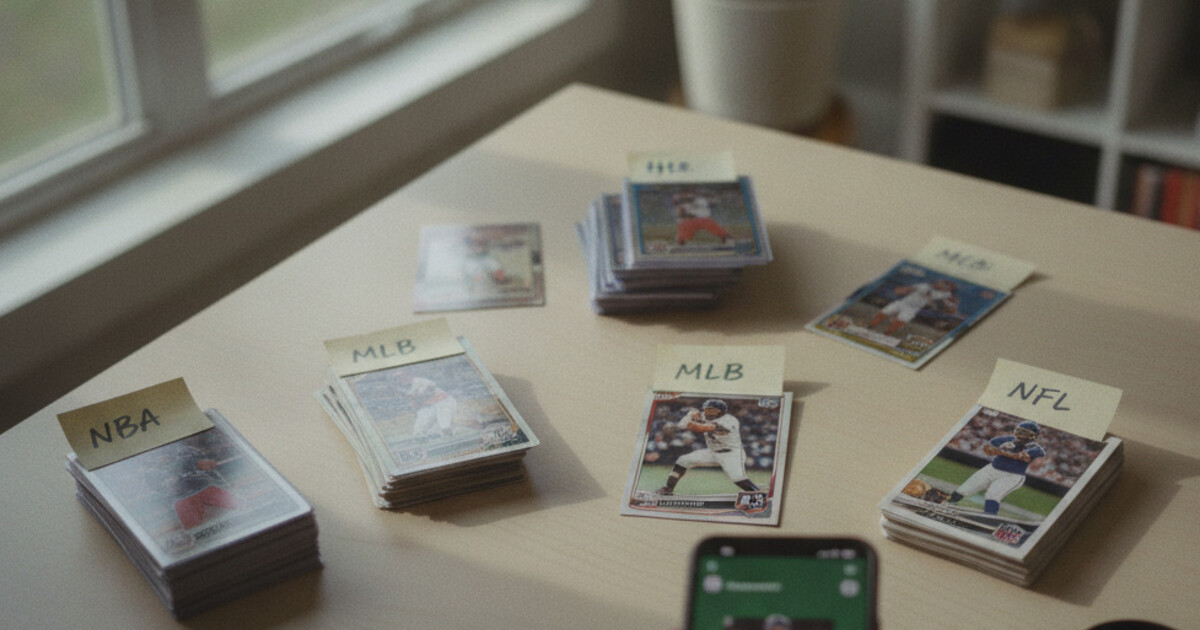
The biggest mistake new collectors make is buying storage first, then sorting into it. Sort first. It costs nothing and saves you from rearranging everything later.
Pick one primary sorting method. The right choice depends on how you collect:
- By sport: Baseball, basketball, football, hockey in separate piles. Simple and fast if you collect across multiple sports.
- By player: Works for player collectors focused on a specific athlete. All your Shohei Ohtani cards together, all your LeBron cards together.
- By team: Good for team collectors who want every player from one franchise in the same place.
- By set and year: Best for set collectors completing specific product runs. A 2024 Topps Chrome set gets its own binder.
- By value: Pull anything visibly valuable (numbered, autographed, relic, or RC-stamped) out of the main pile first. Those cards need different storage than common base cards.
Many collectors use a two-level sort: sport first, then player or team within each sport. Whatever makes it easiest to find any specific card in under two minutes is the right method.
One rule that applies to everyone: separate your valuable cards before anything else. Cards numbered /99 or lower, on-card autos, patch relics, and key rookie cards all get their own pile. They’ll live in better storage and you don’t want them buried in a box of 1991 Score commons.
Card condition directly controls resale value, and unsorted cards in mixed piles pick up scratches, corner dings, and surface wear from sliding against each other. According to PSA grading standards, a card graded NM-MT (Near Mint-Mint, PSA 8) typically sells for 30-50% less than a PSA 10 gem mint copy, while an EX condition (PSA 5) copy can trade at just 5-15% of that price. On a 2018-19 Panini Prizm Luka Doncic base, that gap represents thousands of dollars: raw copies in good condition trade around $40-60, while PSA 10s have sold for $4,000-6,000. Even for lower-value cards, a scratch sustained during casual handling permanently caps the grading ceiling. Sleeving each card immediately after you pick it up, and keeping sorted cards together instead of loose in piles, is the most cost-effective step any collector can take to protect their collection’s long-term value. It takes 3 seconds per card and costs almost nothing.
How to Organize Sports Cards by Category
Once sorted, you can build a filing system that makes sense. Most collectors combine a few of these approaches:
Sport, then player alphabetically: Three labeled binders or boxes (Baseball, Basketball, Football) with A-Z dividers inside each. You can grab any player’s cards in under a minute.
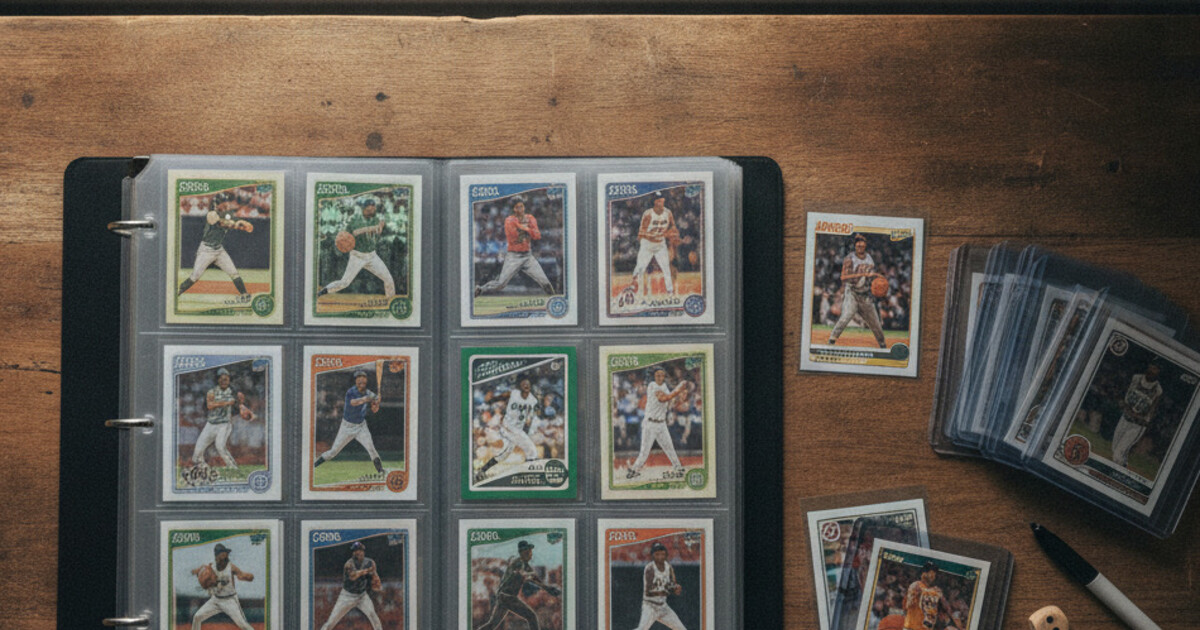
Set-complete runs: One binder per product, cards in sequence by card number. If you’re building a complete 2024 Topps Series 1, every card from #1 to #350 goes in order. Makes it easy to spot which numbers you’re still missing.
Highlights stored separately: Any numbered card, auto, relic, or graded card comes out of the main binder and gets its own toploader or magnetic case. A small flat storage box or a row of toploaders in a dedicated section keeps these accessible without putting them at risk during everyday handling.
Bulk junk wax in decade boxes: Late 1980s and early 1990s base cards from mass-produced sets (1991 Donruss, 1990 Score, 1992 Upper Deck) are nearly worthless by the card but fine to keep as a group. An 800-count box labeled “1988-1994 Bulk” is enough. You don’t need individual tracking here.
When sorting, don’t overthink the system. The goal is finding any specific card within two minutes. If your current setup does that, it works.
See how to read a sports card for help identifying a card’s year, set name, and card number while you sort.
Physical Storage for Sports Cards: Sleeves, Toploaders, Binders, and Boxes
Physical storage has a hierarchy. Match the protection level to the card’s value.
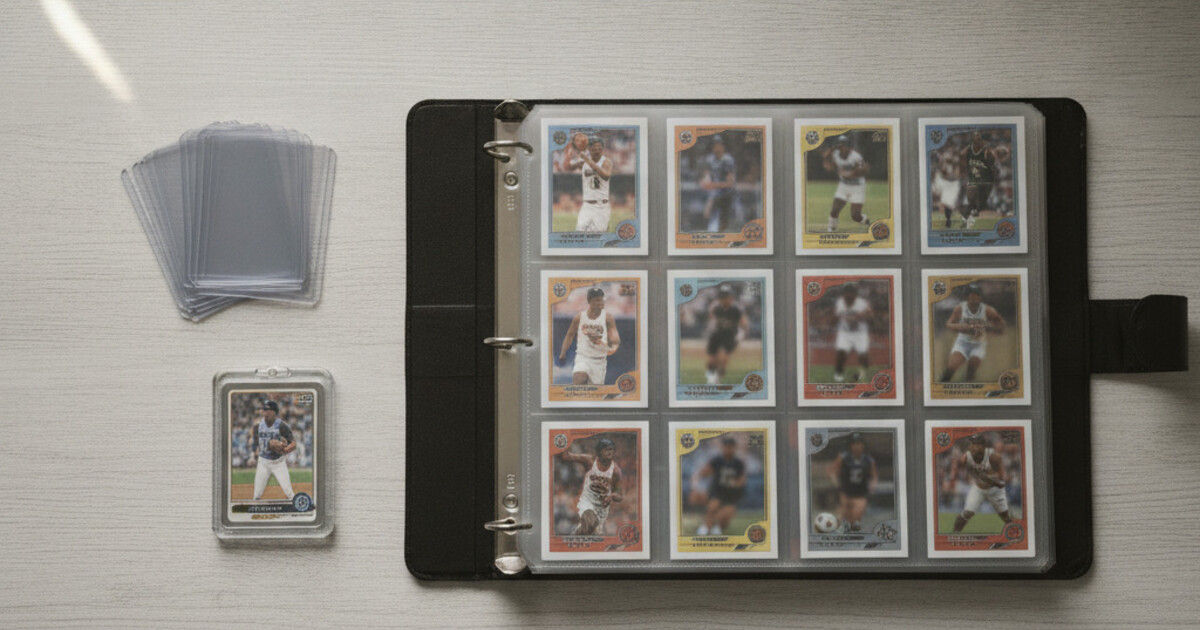
Penny sleeves: Thin plastic sleeves that protect card surfaces from scratches during handling. About $2-4 per 100. Every card should go into a penny sleeve before anything else. Standard penny sleeves fit cards up to about 20-point thickness, which covers almost all modern base cards and most vintage cards.
Toploaders: Rigid plastic holders that protect corners and edges from bending. Standard toploaders fit cards up to 35pt thickness. About $8-15 per 100. Use for any card worth $2 or more. The standard move is to penny sleeve the card first, then slide it into the toploader. This prevents the card from rattling inside and keeps moisture out.
Magnetic one-touch cases: Two-piece magnetic holders that close around the card without stress on edges or corners. Better protection than toploaders for cards worth $20 or more, numbered cards, on-card autos, and relics.
Binder pages: 9-pocket clear pages for standard 3-ring binders. Hold base cards and mid-range cards neatly for browsing. A single binder with 40 pages holds 360 cards. Good for organized set collections and active player collections you like to flip through.
Card storage boxes: Corrugated cardboard or hard plastic boxes that hold hundreds to thousands of cards upright in rows. The 800-count and 3,200-count sizes are the standards. Better than binders for bulk storage because they take less shelf space and cost less per card stored. Not as browsable, but faster to expand.
A few rules that protect cards over time:
- Double-sleeve valuable cards (penny sleeve inside the toploader). The inner sleeve prevents rattling and adds a moisture barrier.
- Keep storage boxes horizontal if stacked. Vertical stacks under weight can crush cards at the bottom over months.
- Store away from humidity and direct sunlight. Heat warps cards; UV exposure fades color over years; humidity causes curling that’s impossible to reverse.
For cards you’re thinking about submitting for grading, graded vs raw cards covers when professional grading is worth the cost and when it isn’t.
App vs. Spreadsheet for Card Inventory
A spreadsheet works at 50 cards and collapses at 500. Every row is typed by hand (player, year, set, card number, parallel — one typo and the record is wrong), and every value is stale the day after you enter it: card prices move with the market, and a spreadsheet only knows what you last pasted into it.
A scanner-based inventory app flips the effort: the scan does the identifying (including the parallel/variation a human mislabels most), the entry logs itself, and values update from market data instead of rotting. Where a spreadsheet still makes sense: custom analysis (pivot tables over purchase price vs. current value), bulk commons you’ll never price individually, or if you simply enjoy the ritual. A practical hybrid is scanning everything worth more than a few dollars and keeping one spreadsheet row for each 400-count box of commons.
Tracking Your Collection’s Total Value Over Time
Organizing tells you where cards are; tracking tells you what they’re worth — and whether that number is moving. Three habits make portfolio tracking actually stick:
- Log cards once, at intake. Scan new pickups the day they arrive. A backlog of 300 unlogged cards is why most tracking attempts die.
- Check values monthly, not daily. Card prices swing with player news; daily checking turns collecting into anxiety. A monthly look is enough to spot real trends — and to catch the right moment to sell a spiking rookie.
- Watch the trend, not the total. A collection “worth $2,400” matters less than knowing it was $1,900 three months ago — or which five cards drove the change. Per-card trend indicators (up/stable/down) tell you where the movement is.
Track Your Sports Card Collection Digitally with Stakks
Physical organization handles the cards. Digital organization handles everything else: knowing exactly what you have, what it’s worth, and where it is.
Stakks lets you scan any sports card with your phone camera. It identifies the player, year, set name, variation, and rarity, then pulls the current estimated market value from real sales data. One scan and the card is logged. No manual entry, no spreadsheet.
From there, you create named collections inside the app. You might have “Ohtani PC” for a player collection, “2024 Prizm Set Build” for an active set project, and “For Sale Maybe” for cards you’re undecided on. Each card goes into whichever collection fits.
Each collection shows a running estimated total value at a glance. Instead of guessing whether your basketball cards are worth $300 or $3,000, you can see the number in seconds.
Practical uses during a collection sort:
- Scan cards from a new lot or pack break before sorting them physically. Know what’s worth protecting before you handle it.
- Build a “Highlights” collection for your best cards. Pull it up any time to see your top holdings.
- Mark cards as Favourites to flag them without moving them to a separate collection.
- Scan an inherited shoebox or estate sale lot quickly. Find out immediately if anything deserves a toploader.
Stakks covers baseball, basketball, football, hockey, and soccer cards. It’s free to start, with a Pro upgrade available for collectors who want to go deeper.
If a card comes back with a high value, what makes a sports card rare explains the 7 factors that drive card prices so you understand why it’s worth what it is.
Frequently Asked Questions
What’s the best way to sort a large sports card collection? Sort by sport first, then by player or team within each sport. Before doing anything else, pull out numbered cards, autos, relics, and rookie cards with an RC stamp. Those get individual toploaders, not binder pages. Once your highlights are separated, the remaining base cards can go into binders or card boxes by team or set. Scanning as you go with a card app logs values while you sort, so you’re not doing two passes.
Do I need penny sleeves for every card? For cards worth less than $0.50, it’s optional. For anything worth $2 or more, a penny sleeve is cheap insurance against surface scratches that permanently lower grading potential. At $2-4 per 100 sleeves, protecting even low-value cards costs almost nothing compared to what condition damage costs in resale value.
Is a binder or a storage box better for organizing sports cards? Binders are better for sets you want to browse, show others, or check for missing cards. Boxes hold more cards per dollar and take less shelf space, but browsing them is slower. Most collectors use both: binders for display sets and active player collections, boxes for bulk base cards and junk wax commons.
How do I keep track of what I have without a spreadsheet? A scanner app like Stakks gives you a running inventory without manual data entry. You scan each card once, assign it to a named collection, and the app tracks the count and estimated value automatically. A digital inventory is also useful for checking whether you already own a specific card before buying a duplicate.
Should I organize cards by player or by set? By player if you focus on specific athletes or run a player collection. By set if you’re completing specific product runs or tracking a checklist. Many collectors do both: a player binder for their main PC and set boxes for everything else. There’s no wrong answer, as long as you can find any card quickly.
If your collection has been sitting in a box for years, Stakks makes the sorting process faster. Scan each card and the app identifies the player, year, set, and estimated market value in seconds. Build named collections for each sport or category, track your total portfolio value, and flag the cards worth watching. Download Stakks free on iOS or Android at stakks.app.